
Why Employee-Oriented Companies Are More Successful in Chemical Custom Synthesis
Excerpt
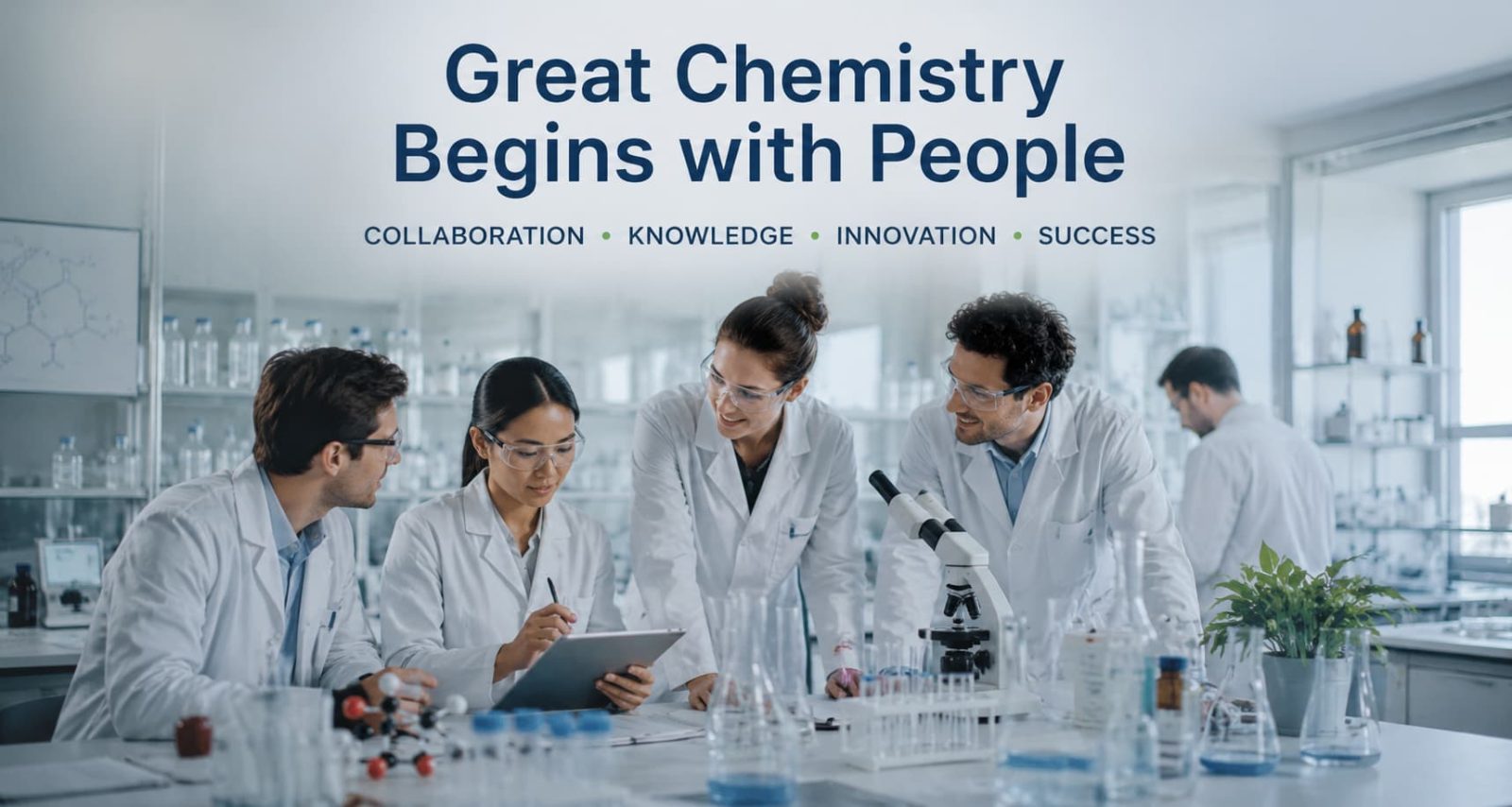
Modern chemical research depends on far more than advanced laboratories and analytical technologies. Employee-oriented leadership, scientific collaboration, and long-term knowledge retention are becoming key competitive advantages in Chemical Custom Synthesis, Contract Research, and Process Development.
Executive Summary
The shortage of highly qualified scientific professionals is changing the competitive landscape for research-driven chemical companies. Organizations that invest in employee development, knowledge sharing, and long-term collaboration often achieve greater innovation, stronger process development, and more sustainable customer relationships. This article explores why employee-oriented leadership has become a strategic factor in Chemical Custom Synthesis and highlights a recent example from the industry.
Why Employee-Oriented Companies Are Becoming a Competitive Advantage in Chemical Custom Synthesis
For many years, competitive advantages in the chemical industry were primarily associated with laboratory equipment, production capacity, analytical technologies, or access to raw materials.
While these factors remain important, another aspect has become increasingly decisive for research-driven organizations:
People.
Across the pharmaceutical, biotechnology, specialty chemicals, and advanced materials industries, companies compete not only for customers but also for highly qualified scientists, process chemists, analytical experts, and engineers.
As research projects become more complex and product life cycles shorten, retaining scientific expertise has evolved into a strategic business priority.
This development is particularly visible in Chemical Custom Synthesis, where many projects involve the development of entirely new synthetic routes rather than standardized production.
The Growing Importance of Scientific Knowledge
Unlike routine manufacturing, custom synthesis projects frequently require the design of completely new chemical pathways.
Scientists may need to
- develop novel synthetic strategies,
- optimize reaction conditions,
- solve analytical challenges,
- redesign published routes,
- or establish scalable manufacturing processes.
Such projects rarely depend on equipment alone.
They depend on accumulated scientific experience.
Practical laboratory knowledge.
Critical thinking.
And close collaboration between specialists from different disciplines.
Organizations that retain this expertise over many years build an increasingly valuable knowledge base that benefits every future project.
Why Employee Retention Matters
Knowledge-intensive industries have always relied on experienced professionals.
However, demographic change and the ongoing shortage of qualified scientists are making employee retention more important than ever.
According to Germany’s Competence Centre for Skilled Labour (KOFA), approximately 71.7% of Germany’s skilled labour shortage affects small and medium-sized enterprises (SMEs).
At the same time, many experienced professionals are approaching retirement while fewer graduates enter technical and scientific professions.
For research organizations, this creates two significant challenges.
First, attracting qualified scientists.
Second, preserving valuable scientific expertise over the long term.
Every experienced chemist carries years of practical knowledge that cannot simply be documented in laboratory notebooks.
This tacit knowledge often determines whether a challenging synthesis becomes commercially viable.
Corporate Culture and Scientific Excellence
Corporate culture is often discussed from an HR perspective.
For research organizations, however, it also has scientific significance.
A collaborative environment encourages researchers to
- exchange ideas,
- question assumptions,
- discuss failures openly,
- and continuously improve experimental approaches.
Such environments accelerate innovation because scientific knowledge grows through interaction rather than isolation.
The most successful research teams are rarely those with the most expensive equipment.
They are often those that communicate most effectively.
The Link Between Employee Orientation and Innovation
Employee-oriented companies generally invest in
- continuous professional development,
- modern leadership,
- knowledge transfer,
- interdisciplinary collaboration,
- and long-term career opportunities.
These investments improve more than employee satisfaction.
They strengthen scientific continuity.
Stable project teams retain valuable expertise, reduce knowledge loss, and improve customer communication throughout long-term development projects.
For customers seeking a contract research or custom synthesis partner, this often translates into
- greater reliability,
- faster problem-solving,
- more robust process development,
- and improved project outcomes.
A Recent Industry Example
One recent example illustrating this broader trend is ChiroBlock GmbH, an independent German provider of Chemical Custom Synthesis, Route Scouting, and Process Development.
The company recently received the Employee-Oriented Company Award for the fifth consecutive time, recognizing its sustained commitment to employee development and corporate culture.
While the award is specific to one organization, it reflects a wider movement across knowledge-intensive industries:
Scientific excellence increasingly depends on creating workplaces where experienced researchers remain, collaborate, and continue developing their expertise over many years.
This trend extends well beyond a single company and is becoming increasingly relevant throughout the global chemical industry.
Why This Matters for Customers
Selecting a research partner involves much more than evaluating technical capabilities.
Customers increasingly seek organizations that offer
- stable scientific teams,
- long-term project continuity,
- transparent communication,
- robust development processes,
- and reliable knowledge retention.
An employee-oriented organization is often better positioned to provide exactly these qualities.
Strong corporate culture ultimately becomes a quality factor for scientific collaboration.
Conclusion
Innovation in chemistry has never depended solely on technology.
Modern laboratories, digital tools, and artificial intelligence continue to transform research.
Yet they cannot replace scientific curiosity, practical laboratory experience, or collaborative problem-solving.
As the chemical industry continues to evolve, employee-oriented leadership is becoming a strategic component of innovation management.
Organizations that successfully attract, develop, and retain scientific talent are likely to remain at the forefront of Chemical Custom Synthesis, Contract Research, and Process Development.
For research-driven companies, investing in people is increasingly becoming an investment in scientific excellence.
Further Reading
One recent article explores this topic in greater depth by examining the relationship between employee-oriented leadership, scientific collaboration, and innovation in chemical research, using a practical industry example.
Read the full article:
Why Great Chemistry Begins with People
( https://www.chiroblock.com/employee-oriented-company-chiroblock/)
Key Takeaways
✔ Scientific excellence depends on experienced people.
✔ Employee retention preserves valuable research knowledge.
✔ Corporate culture directly influences innovation.
✔ Stable project teams improve scientific collaboration.
✔ Long-term expertise benefits customers.
✔ Employee-oriented companies are better positioned for sustainable innovation.
Questions Answered in This Article
- Why are employee-oriented companies becoming more competitive?
- How does employee retention influence chemical custom synthesis?
- Why is corporate culture important for research organizations?
- How do stable scientific teams improve customer success?
- Why is scientific knowledge a long-term competitive advantage?
Interested in learning more about Chemical Custom Synthesis, Contract Research, Route Scouting, and Process Development? Explore our knowledge base for practical insights, scientific articles, and industry perspectives covering the latest developments in custom chemical synthesis and research services.
Comments
Spot on. In custom synthesis, advantages compound where people stay: tacit lab know‑how, faster troubleshooting, and trust built over long projects. Equipment parity is easy; continuity isn’t. Investing in mentorship, knowledge capture, and collaborative culture turns variability into reproducibility—and that’s what scales from gram to kilo. Congrats to teams proving that retaining scientists is a process-optimization strategy, not just an HR metric.
Thank you for this excellent insight. We completely agree that equipment can be purchased, but experience and continuity have to be built over time.
Your observation that retaining scientists is a process optimization strategy rather than just an HR metric really resonates with us. In our experience, long-term collaboration, knowledge sharing, and trust within project teams are essential for transforming promising laboratory chemistry into robust, scalable processes.
Thanks for adding such a valuable perspective to the discussion.