Costs in Chemical Custom Synthesis
This FAQ explains how costs arise in chemical custom synthesis, using concrete examples that chemists and materials scientists encounter in everyday R&D work.
Why Does Chemical Custom Synthesis Cost What It Costs?
Chemical custom synthesis is not the purchase of an existing product that is being manufactured on a regular basis. It is a scientific development process that may include route design, optimization, purification, analytics, and scale-up planning.
Costs reflect:
- Scientific complexity
- Addressing technical risks
- Experimental efforts
- Analytical and documentation requirements
- Reproducibility and scalability
Why Is the Price Not Linear from mg to g to kg?
Because most of the work happens before the first gram exists.
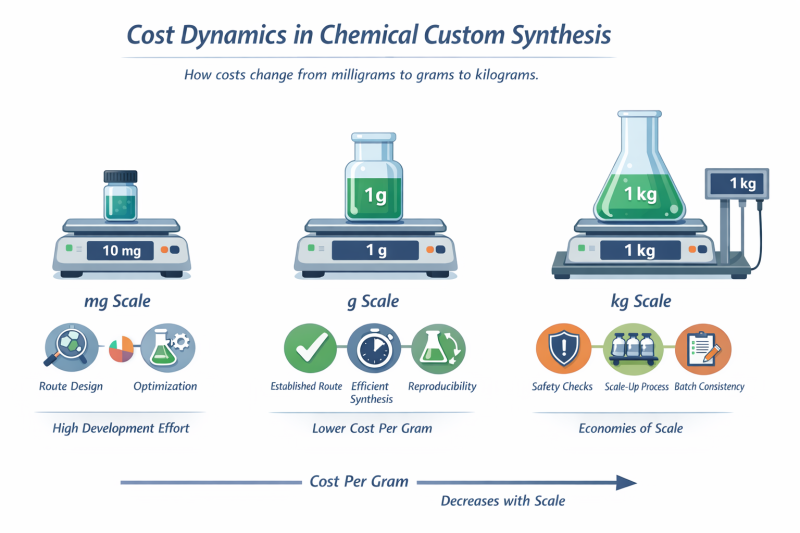
In other words: The main costs do not derive from starting materials but from labour involved in developing the synthetic route, in synthesis, purification, analytics and documentation.
Illustrative Example: Same Molecule, Different Quantities
| Quantity | Typical Work Required | Why Cost per Gram Changes |
| 10 mg | Route design, test reactions, purification, full analytics | High development effort for very little material |
| 1 g | Same route and purification, optimized conditions, similar analytics | Same developmental costs → lower cost per gram |
| 1 kg | Identical route and analytics; Scale-up, safety evaluation, batch reproducibility | Much more starting materials, but the same basic development plus some work on scaling-up; |
Key message:
The scientific effort to make the first milligrams is often similar to making grams, which is why small quantities appear expensive.
Example: Why 10 mg Can Cost Almost as Much as 1 g
This question basically was already answered above:
For a new compound:
- Route scouting: required
- Addressing technical risks: required
- Safety evaluations: required
- Reaction optimization: required
- Purification method development: required
- NMR, HPLC, MS: required
These steps are needed regardless of the final quantity.
Once the route turns out to work:
- Producing more material mainly increases reagent and time costs
- The price per gram decreases, even though the total project cost increases
Hence, making just 10 mg of any new compound with no economy of scale effects is always substantially more expensive (per mass) compared to larger amounts.
Why Does Purity Have Such a Strong Impact on Cost?
Because purity is controlled experimentally, not mathematically.
Illustrative Example: 95% vs >99% Purity
| Purity Level | Typical Impact |
| ~95% | One purification step, standard analytics |
| >98% | Plus: Additional purification, tighter control, more expensive, purer reagents / solvents required |
| >99% | Plus: Multiple purification cycles, yield loss, extended analytics |
Increasing purity often means:
- More chromatography or recrystallization
- Lower overall yield
- More solvent, time, and analysis
- More costly reagents / solvents
Scientific reality:
Going from 95% to >99% purity can double the experimental effort, even though the molecule is the same.
This effect is well known – also outside of chemistry. The first 80 to 90% of a way, a project, a venture are normally much easier (cheaper) to complete than the remaining 10 to 20%.
Purity can only be assessed together with the analytical method, relevant impurities and intended use. The related guide on commercial availability and application-specific specifications explains how to determine whether a catalogue product is actually suitable before additional purification or custom synthesis is commissioned.
Why Does Scale-Up (g → kg) Not Increase Cost Proportionally?
The answer here also is based on the explanations above.
Scale-up benefits from:
- Established reaction conditions
- Known purification methods
- Optimized work-up procedures
However, additional effort may include:
- Safety and hazard evaluation
- Heat and mass transfer considerations
- Batch reproducibility testing
Despite this, cost per gram usually drops significantly at kg scale. The “economy of scale” is a well known effect in economy. The larger the production batch size, the greater the impact.
What Is a Fixed-Price (Fee-for-Results) Project?
In a fixed-price project, the synthesis partner agrees to deliver a defined scientific result for a fixed cost.
Typical Fixed-Price Definition Parameters
- Specific compound
- Minimum quantity (e.g. 5 g)
- Defined purity (e.g. ≥98% HPLC)
- Agreed analytics (NMR, HPLC, MS)
When Does This Works Well?
- With Known chemistry
- With Clearly defined targets
- With Limited uncertainty
- With a sophisticated risk assessment and managing system
When It Is Risky
- With New or unexplored chemistry
- With Unknown stability or reactivity
- With too demanding or Changing specifications
Why Are Sometimes Advance Payments or Minimum Budgets Required?
Because synthesis starts with real laboratory work from day one.
Projects with high technical risks, with extremely costly starting materials require substantial investments at the service provider’s side. Especially in cases where the client has never placed an order before or where they can not show a long-term financial stability, such up-font payments are required to mitigate the financial risks.
Advance payments often cover:
- Feasibility experiments
- Expensive starting materials
- The setup of reactions and analytics
- Allocation of substantial personnel and lab capacity
They ensure that:
- Work can start immediately
- Quality standards are maintained
- The project receives appropriate scientific focus
- The service provider does not take the entire risk of financial issues at the sponsor’s side.
Advance payments are usually credited against the total project cost.
So, in fact they are just special payment terms and do not affect the total price. Basically, the agreement of advance payments even can lower the project costs as the financial risks have been addressed.
How Should Researchers Choose the Right Project Model?
From a research perspective, consider:
| Project Stage | Recommended Model |
|---|---|
| Early exploration | Flexible, exploratory project, varying payment models |
| Lead optimization | Mixed model (milestones) |
| Known target molecule | Fixed-price (fee-for-results) |
| Scale-up / follow-up | Defined scope with scalability focus |
An experienced synthesis partner will help align the project model with scientific risk and research goals.
The earlier a fixed-price model is offered, the more reliable and experienced a synthesis partner normally is.
Summary for Researchers/ Sponsors
- Costs reflect scientific effort, not just quantity of material
- mg-scale synthesis can be as complex as g-scale
- Purity requirements strongly influence effort and cost
- Scale-up reduces cost per gram but adds technical checks
- Clear specifications lead to predictable outcomes
- A project tailored contract mitigating technical and financial risks is at least as important as finding the right outsourcing partner.
Understanding these principles helps researchers plan realistically, communicate clearly, and collaborate effectively in chemical custom synthesis projects.
Request a cost estimated for your project