
Costs & Contract Models in Chemical Custom Synthesis
Chemical custom synthesis follows different pricing and contracting principles than catalog chemicals. This sounds logical to many but – according to our experiences – is not in the mind of everyone who is looking for such services. For procurement teams, understanding these principles is essential to ensure budget control, risk management, and supplier alignment.
This FAQ explains how costs are calculated, why pricing is non-linear, and how common contract models work in professional chemical custom synthesis. Of course, every single request, project, synthesis and contract is different – but some general features can always be found.
How Are Costs Calculated in Chemical Custom Synthesis?
In chemical custom synthesis, pricing is based on scientific effort, on project complexity and on a technical risk evaluationnot only on the final quantity delivered.
Key cost drivers include:
- Molecular complexity and novelty
- Number of synthesis steps
- Availability and cost of raw materials
- Development and optimization effort
- Required analytical characterization
- Purity of the product
- Safety, regulatory, and handling requirements
- Scalability and reproducibility expectations
- Scope of documentation and IP transfer
- The flexibility regarding many side parameters such as delivery time, reporting, the very target amount and numbers of allowed batches per target amount
From a procurement perspective, custom synthesis should be viewed as a developmental service with a material deliverable (plus information), rather than a simple purchase of goods.
Why Is the Price Not Linear with Quantity?
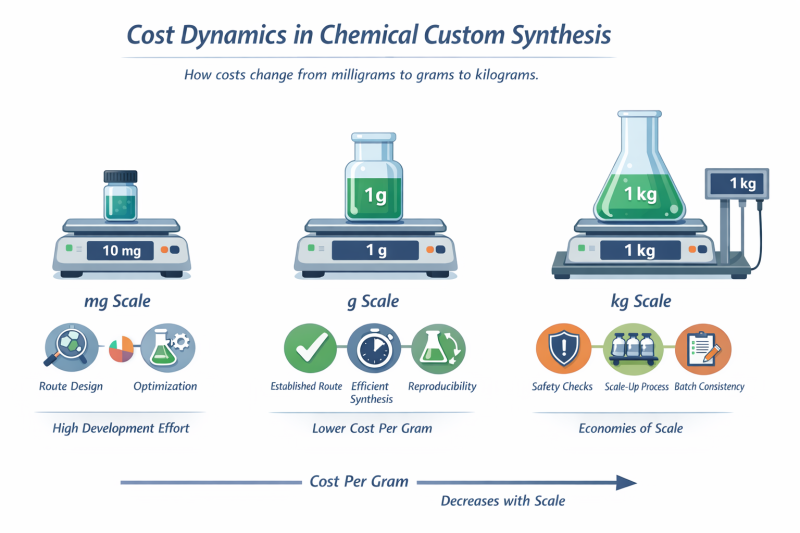
The short answer to this important question is: Because most of the cost factors do not scale in a linear way. Sometimes efforts relatively decrease with the amount (e.g. documentation, administration). Other factors may nearly linearly depend on the quantity (e.g. costs for drying the product). And there are factors that even increase disproportionately with the amount (e.g. costs for special chromatography). To make things even more complex: There are certain steps in the (relative) price-amount ratio that depend on synthesis specific batch sizes for single steps and operations.
Procurement teams often expect kind of linear pricing models. In chemical custom synthesis, this assumption does not apply.
General reasons for non-linear pricing:
- Initial development costs are largely independent of scale
- The question here simply is: Who bears these costs and how much product will be made on the basis of these developmental efforts?
- Route scouting, optimization, and analytics are required even for small quantities
- In some cases, the costs for analytics can exceed those of making the compound!
- Once a synthesis route is established, normally marginal cost per gram decreases with scale can be observed
- In turn, this also means, an amount reduction by e.g. 50% on a 100 mg scale does only result in marginal cost savings.
As a result:
- Small quantities may appear relatively expensive
- While larger quantities as usual benefit from amortized development costs, additional features of a “custom synthesis” (such as a very limited total production volume and a very limited customer base) have to be considered
This explains why price-per-gram typically decreases with increasing order size – but not in a clearly predictable manner.
Why Does Purity Significantly Influence Cost?
Purity requirements directly impact process complexity, yield, and analytical workload.
Higher purity levels often require:
- Additional purification steps
- Purer (more expensive) starting materials
- Tighter process control
- Increased material losses
- More extensive analytical verification
The take home message here: For procurement, it is critical to define fit-for-purpose purity specifications. Over-specification can significantly increase cost without adding value to the end application.
What Contract Models Are Common in Chemical Custom Synthesis?
Two primary contract models are normally used:
- Resource Based Projects
- Fixed-Price (Fee-for-Results) Projects
There is also a third model considering Royalty Payments or otherwise shared risks and successes at both sides. However, this requires a very deep mutual understanding and is quite complex in reality. So, this model is not further discussed here.
Each model allocates risk, flexibility, and budget predictability differently.
Cost Comparison: Resource-based vs. Fixed-Price Projects
Overview Table
| Aspect | Resource based | Fixed-Price (Fee-for-Results) |
| Cost predictability | Medium | High |
| Flexibility | High | Limited |
| Technical risk | Shared | Mostly supplier |
| Scope definition | Flexible | Strictly defined |
| Change handling | Easy | Requires contract amendment |
| Best suited for | Early-stage, high uncertainty | Well-defined, proven chemistry |
Procurement Perspective: When to Use Which Model
Resource-Based (Time-and-Materials)
Best suited when:
- Chemistry is novel or high-risk
- Multiple routes need evaluation
- Specifications may change during the project
- An easy price comparison of competing suppliers is required.
Procurement benefit:
Maximum flexibility and transparency of effort.
Easy handling of large volume contracts.
Procurement consideration:
Requires active cost monitoring and milestone control.
It is hard to anticipate what the service provider finally will deliver.
It is nearly impossible to compare different service providers in advance.
More expensive if the vendor doesn’t perform well.
Fixed-Price (Fee-for-Results)
Best suited when:
- Target molecule, quantity, and purity are clearly defined
- Feasibility is well understood
- Budget certainty is required
- Having no chemistry expertise at the customer’s side
- Placing the first orders with new suppliers.
Procurement benefit:
High cost predictability and simplified budgeting.
Procurement consideration:
Less flexibility; changes may trigger additional costs.
More expensive if the anticipated technical risks turn out to be smaller.
How Do Fixed-Price (Fee-for-Results) Projects Work?
In a fixed-price model, the supplier commits to delivering defined results for an agreed price, typically including:
- A specified compound
- A minimum quantity
- Defined purity and analytical documentation
This model transfers the main part of the technical risk to the supplier and requires clear success criteria and realistic specifications.
Are There Minimum Budgets or Advance Payments?
Generally: Yes – but this depends on the vendor, on the project and on the trust both partners ha in each other. In chemical custom synthesis, minimum project budgets and advance payments are more or less standard B2B practice.
Why Advance Payments Are often Required
- Cover initial feasibility assessment and setup
- Secure laboratory capacity and raw materials
- Reduce financial risk for development-intensive work
- Enhance the trust in the sponsor’s financial capacity
Advance payments are usually credited against the total project cost and are common in contract research and custom synthesis environments.
Key Takeaways for Procurement Teams
- Chemical custom synthesis costs are mainly driven by scientific effort and many other factors but not only by quantity
- Pricing is non-linear by design, especially at smaller scales
- Purity requirements must be aligned with application needs
- Contract model selection directly affects risk, flexibility, commitment and budget control
- Transparent communication with the synthesis partner is essential
- Many side parameters can be agreed on (IP-transfer, exclusivity, preferential handling of orders, details of reporting, regulatory work an much more) – but consider: All these factors do impact the price in very different ways!
Conclusion
For procurement professionals, successful chemical custom synthesis sourcing requires a deep understanding cost drivers, non-linear pricing, and appropriate contract models. Selecting the right project structure ensures cost efficiency, predictable outcomes, and long-term supplier partnerships.
Experiences service suppliers even offer consulting on these issues.
A qualified chemical custom synthesis provider will actively support procurement teams in choosing the most suitable pricing and contract approach for each project.
Request a binding quote for your project