
Chemical Custom Synthesis Across Development Stages: From Discovery Scale to Commercial Manufacturing
Introduction
Chemical custom synthesis is far more than the preparation of a molecule. Successful projects require scientific expertise, route scouting, process development, analytical characterization, risk management, and scalable manufacturing strategies. Understanding how requirements evolve from milligram quantities to commercial production helps organizations select the right synthesis partner and avoid costly mistakes.
Why Scale Matters in Chemical Custom Synthesis
The challenges associated with custom synthesis change dramatically with scale. A route that works perfectly at milligram scale may become economically unfeasible, unsafe, or impossible to reproduce at kilogram scale. Therefore, scale considerations should be incorporated from the earliest stages of project planning.
The Four Development Phases
- Discovery Scale: feasibility and proof of concept.
- Development Scale: route optimization and material generation.
- Process Development Scale: robustness, safety, and reproducibility.
- Commercial Manufacturing Scale: long-term supply and economics.
Why Route Scouting Determines Project Success
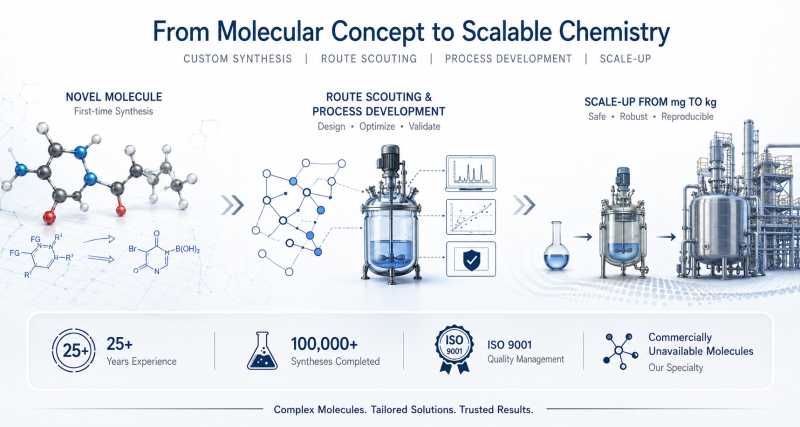
Route scouting is one of the most important investments in any synthesis project. Evaluating alternative pathways can significantly reduce costs, improve yields, enhance safety, and simplify future scale-up activities.
How Challenges Change with Scale
Milligram scale focuses on feasibility. Gram scale focuses on reproducibility. Kilogram scale focuses on process safety and robustness. Commercial manufacturing focuses on economics, regulatory compliance, and supply chain security.
Analytical Requirements Across Development Stages
Analytical requirements evolve from basic identity confirmation (NMR, MS, HPLC) to validated methods, impurity profiling, stability studies, and regulatory documentation.
Process Safety and Risk Assessment
Safety becomes increasingly important during scale-up. Thermal stability studies, calorimetry, hazard assessments, and process risk evaluations help prevent costly failures and ensure safe manufacturing.
Cost Drivers in Custom Synthesis
At small scales, scientific labor is the main cost driver. During scale-up, process development becomes critical. At commercial scale, raw material sourcing, yield optimization, and facility utilization dominate project economics.
How to Select a Custom Synthesis Partner
Organizations should evaluate scientific expertise, route scouting capabilities, analytical infrastructure, project management, IP protection, scale-up experience, and long-term manufacturing capabilities.
Why ChiroBlock
ChiroBlock specializes in first-time synthesis, commercially unavailable compounds, route scouting, process development, and scale-up from mg to kg. With more than 25 years of experience and over 100,000 syntheses completed, ChiroBlock supports customers in pharma, biotech, academia, materials science, and specialty chemicals.
Frequently Asked Questions
What is chemical custom synthesis?
Why is route scouting important?
How long does a synthesis project take?
What information is required for a quotation?
How does scale-up affect cost and timelines?
Do you need a commercially unavailable molecule? Contact ChiroBlock for a confidential project evaluation, feasibility assessment, and custom synthesis quotation.
contact us for project evaluation