How to Select the Best Synthesis Route for a Chemical Project
Editorial responsibility: Chemical Custom Synthesis Editorial Team
Expert perspective: Dr Oliver Seidelmann, ChiroBlock GmbH
Quick answer
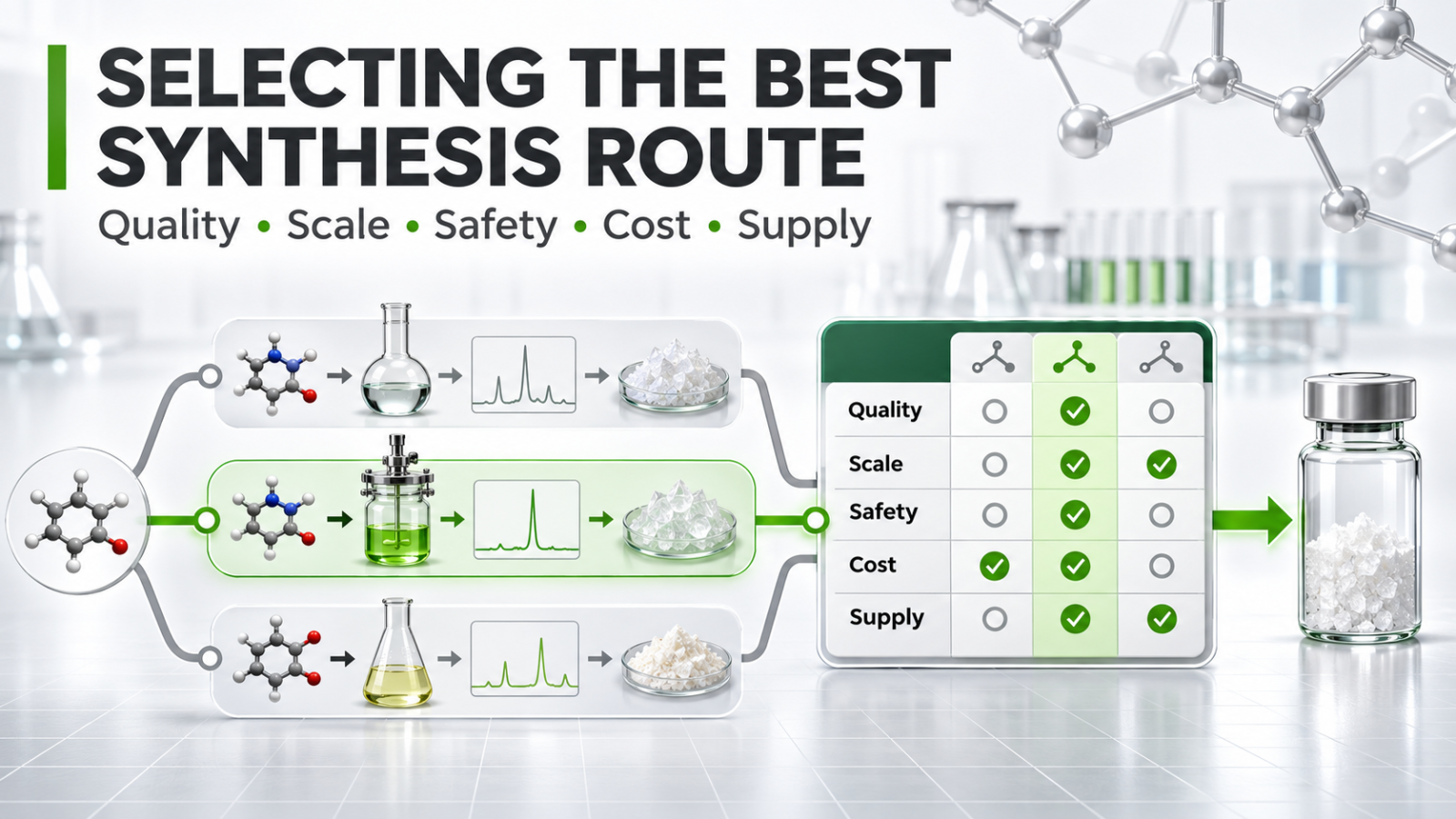
The best synthesis route is the route that delivers the required product quality, quantity and documentation with an acceptable combination of technical risk, cost, safety, scalability, purification effort, raw-material availability and intellectual-property freedom. The highest-yielding or shortest route is not automatically the best overall choice. A defensible selection starts with a weighted requirement profile, compares complete routes on the same basis and tests the critical assumptions experimentally.
Key takeaways
- Chemical feasibility is only the first gate in synthesis route selection.
- Yield must be evaluated together with product quality, route length, work-up, purification, safety, scale and total material demand.
- Project priorities should be defined and weighted before alternative routes are compared.
- Literature and patent data generate hypotheses; laboratory evidence determines whether a route is reproducible and suitable.
- A route selected for discovery quantities may be unsuitable for repeat supply or kilogram-scale manufacture.
- The optimum route can change when the specification, annual demand, production site or regulatory context changes.
Why is the highest-yielding route not always the best?
A high isolated yield is attractive because it appears to promise efficient use of starting material. However, the value can be misleading when it is considered without the rest of the process. A 90% reaction followed by difficult chromatography, repeated solvent exchanges and an unstable isolation may be less useful than a 75% reaction that produces a crystalline intermediate with a clean impurity profile.
The same applies to route length. A short route can contain one hazardous, supply-constrained or poorly selective transformation that dominates the complete project risk. A slightly longer route may use robust chemistry, readily available starting materials and scalable isolations. The relevant question is therefore not “Which route has the highest reported yield?” but “Which complete route best meets the defined project requirements?”
This distinction becomes increasingly important when a compound moves from first-time preparation to recurring supply. The requirements that change across discovery, development and manufacturing are described in Chemical Custom Synthesis Across Development Stages.
Which criteria should be used to compare synthesis routes?
A useful route comparison covers the complete pathway from defined starting materials to isolated product. All candidates should be evaluated against the same target specification, scale and system boundary.
| Assessment area | Questions to answer | Evidence |
|---|---|---|
| Product quality | Can the route consistently deliver the required identity, form, assay, stereochemistry and impurity profile? | Representative analytical data, impurity knowledge and repeat experiments |
| Overall yield and route length | What is the isolated overall yield? How many reactions, work-ups, isolations and protecting-group operations are required? | Step yields, mass balance and complete process sequence |
| Purification | Can intermediates and product be isolated by scalable operations, or does the route depend on chromatography or repeated reprocessing? | Crystallisation, extraction, distillation, filtration or other isolation data |
| Safety | Do reagents, intermediates, heat release, pressure, gas evolution or dosing create unacceptable risk at the intended scale? | Hazard review, thermal data and scale-appropriate safety assessment |
| Raw materials | Are starting materials, catalysts and critical reagents available in the required quality and quantity from a resilient supply base? | Supplier confirmation, specification, lead time and sourcing alternatives |
| Equipment fit | Can the process be executed in realistic reactors and downstream equipment at the intended site? | Equipment list, operating ranges and facility constraints |
| Cost | Which operations and materials dominate total cost rather than the cost of one reaction? | Material, labour, analytical, equipment and waste-treatment assumptions |
| Material and environmental burden | How much solvent, water, reagent and auxiliary material is required per unit of acceptable product? | Mass balance and metrics such as process mass intensity within a defined boundary |
| IP position | Are the route, intermediates or required catalysts restricted by patents, licences or contractual rights? | Professional freedom-to-operate assessment where required |
| Transfer and repeatability | Can the process be documented, reproduced and transferred without relying on undocumented operator knowledge? | Controlled procedure, process observations, analytical controls and deviation history |
No single criterion should be treated as a universal winner. Even sustainability requires a defined measurement boundary. The American Chemical Society describes process mass intensity as a practical metric for measuring the total material input relative to product output, but it should be interpreted together with safety, energy, toxicity and project-specific constraints.
A practical six-step framework for synthesis route selection
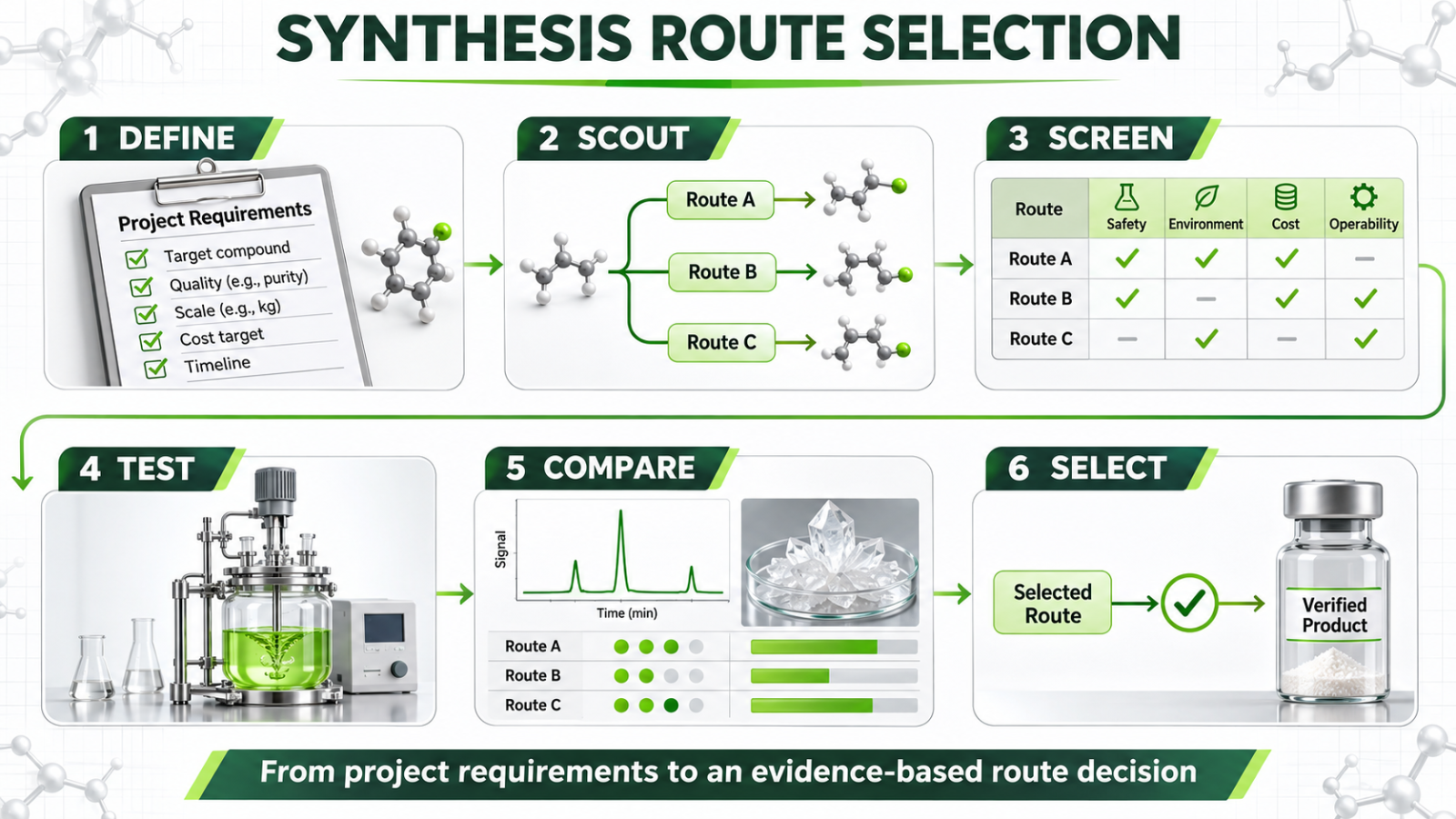
1. Define the target product and intended use
Route selection begins with the actual product requirement, not only the molecular structure. Define the required stereoisomer, salt or solvate form, quantity, purity, assay, critical impurities, analytical package, delivery form and expected future demand. A route cannot be judged without knowing what it must deliver.
2. Translate the project context into weighted criteria
Not every criterion has equal importance. For one project, maximum stereochemical purity may be decisive. For another, the dominant requirements may be kilogram-scale supply, low target cost and avoidance of chromatography. Assigning weights before route comparison reduces the risk of selecting a chemically elegant route that does not solve the commercial or technical problem.
3. Identify realistic route candidates
Route scouting combines retrosynthetic analysis, literature and patent searching, internal experimental knowledge, starting-material availability and knowledge of related transformations. Candidates may include conventional organic synthesis, biocatalysis, fermentation, semisynthesis, extraction or hybrid strategies. At this stage, alternatives should not be rejected simply because they use different technologies.
4. Eliminate routes with fundamental incompatibilities
A rapid screening should identify non-negotiable conflicts: unavailable starting materials, unacceptable IP exposure, prohibited solvents, incompatible pressure or temperature, an unmanageable impurity risk or a purification method that cannot support the intended scale. Early elimination prevents resources being spent on routes that cannot satisfy the project brief.
5. Test the critical assumptions experimentally
Published yields are not enough. The most decision-relevant steps should be tested using representative materials and suitable analytical methods. Experiments should examine selectivity, impurity formation, work-up, isolation, reproducibility and sensitivity to realistic parameter changes. The objective is not to optimise every candidate fully, but to generate evidence that distinguishes them.
6. Select, document and challenge the preferred route
The preferred route should be supported by a transparent decision record: criteria, weighting, data, assumptions, unresolved risks and reasons for rejecting alternatives. Before committing to scale-up, challenge the decision against likely changes in batch size, specification, supplier, equipment and production location.
When is optimisation sufficient—and when is route redesign required?
| Situation | Likely response |
|---|---|
| The route is fundamentally suitable, but one reaction has moderate conversion or long cycle time. | Targeted reaction and process optimisation |
| The chemistry works, but isolation or impurity control is unreliable. | Work-up, crystallisation or purification development; reassess upstream impurity formation |
| A key reagent or solvent is hazardous, restricted or difficult to source. | Evaluate replacement chemistry or redesign the affected route section |
| The route depends on chromatography that is unsuitable for the required quantity. | Redesign isolation strategy, reaction sequence or intermediate form |
| The current route cannot achieve the required stereochemistry or impurity profile. | Broader route scouting and possible route redesign |
| The route is protected by third-party IP or relies on a licensed technology. | Professional IP assessment and alternative-route development |
| Several constraints fail simultaneously. | Rebuild the requirement profile and perform complete route selection again |
Many apparent “last-step problems” originate earlier in the sequence. Impurities, protecting-group choices and unstable intermediates can accumulate until the final transformation exposes them. The related article Why Do So Many Chemical Syntheses Fail in the Final Step? explains why changing upstream chemistry can be more effective than repeatedly adjusting the last operation.
Case example: selecting a route to (2R,3S)-isocitric acid
A practical route-selection case for (2R,3S)-isocitric acid illustrates why the requirement profile matters. The target is highly polar, stereochemically defined and difficult to separate from structurally related hydroxycarboxylic acids. Several broad approaches can be considered, including extraction from natural materials, fermentation and routes combining conventional synthesis with biocatalytic steps.
For a project prioritising scale, cost, raw-material availability and scalable purification, the selected concept combined standard organic chemistry, a yeast-mediated stereoselective transformation and enzyme-assisted hydrolysis. A different specification that placed maximum stereochemical purity or another regulatory context first could justify another route.
The lesson is not that one technology is generally superior. It is that a route becomes “best” only in relation to an explicit set of constraints. The complete expert case is documented by Dr Oliver Seidelmann in Synthesis Route Redesign: A Real-World Case Study.
Which evidence should be available before scale-up?
- A controlled procedure with clearly defined quantities, order of addition, temperatures, times and work-up operations
- Identity, assay, purity and impurity data generated with fit-for-purpose methods
- Repeat experiments showing that acceptable results are not a one-off event
- Information on critical raw-material attributes and realistic suppliers
- An initial process-safety assessment appropriate to the chemistry and intended scale
- Evidence that the isolation and purification concept fits the target quantity
- Known parameter sensitivities, unresolved risks and contingency options
- A documented basis for the route decision and rejection of material alternatives
Scale-up introduces mixing, heat-transfer, mass-transfer and equipment effects that may not be visible in a small flask. The most common pitfalls are summarised in From Milligrams to Kilograms: Common Scale-Up Mistakes. If the route will later be transferred to a regulated manufacturing site, the required knowledge package should also be considered early rather than assembled retrospectively.
Common route-selection mistakes
- Optimising before defining the product: improving a reaction without knowing the required material form or impurity limits.
- Comparing reported yields directly: overlooking different analytical methods, isolation practices and substrate scales.
- Ignoring the work-up: treating extraction, solvent exchange, filtration and drying as secondary details.
- Assuming catalogue availability: selecting a route around a starting material that cannot be obtained in the required quality or quantity.
- Using one metric as a sustainability claim: presenting yield, atom economy or PMI as a complete environmental assessment.
- Deferring analytics: attempting process optimisation without reliable methods for conversion, impurities and product quality.
- Separating route selection from scale: choosing discovery chemistry without considering foreseeable production constraints.
Availability should be verified for the actual product and starting materials rather than inferred from a catalogue entry. A structured check is provided in How to Verify the Commercial Availability of a Chemical Compound. Cost comparisons should likewise include scientific development, purification, analytics and scale-up effort; see Costs in Chemical Custom Synthesis.
When should route selection be outsourced?
External support can be useful when internal resources are focused on the application rather than synthetic chemistry, when several technology families must be compared, when route decisions require new laboratory evidence or when an independent assessment of cost, risk and scale is needed. A suitable development partner should be able to explain the assumptions behind its recommendation, discuss alternatives and generate reproducible evidence—not merely provide a retrosynthetic proposal.
One provider example is ChiroBlock’s chemical custom synthesis and route-development service. Its ReDesignFactory combines route scouting, experimental process development and project-specific scale assessment. Provider selection should nevertheless be based on the chemistry, required scale, quality system, documentation, equipment and commercial model needed for the individual project.
Conclusion
The best synthesis route is not an abstract property of a molecule. It is the route that best fits a defined product, application, scale and operating environment. A robust decision therefore combines chemistry with analytical evidence, purification, safety, sourcing, equipment, cost, IP and transfer requirements. Defining those requirements before route scouting makes the final choice more transparent, defensible and useful for the next development stage.
Frequently asked questions
What is synthesis route selection?
Synthesis route selection is the structured comparison of alternative pathways to a target compound against defined criteria such as product quality, yield, safety, cost, scale, purification, raw-material availability and IP.
Is the shortest synthesis route usually the best?
No. A short route may contain a hazardous, poorly selective or difficult-to-purify step. A longer route can be preferable when it is more robust, scalable and compatible with the required product quality.
How should yields from different routes be compared?
Compare isolated overall yields using equivalent product-quality targets and include all reaction, work-up and purification operations. Reported yields obtained at different scales or with different analytical definitions are not automatically comparable.
What is the difference between route scouting and route optimisation?
Route scouting identifies and compares different strategic pathways to the target. Route optimisation improves a selected pathway, reaction or operation. A route-redesign project can combine both activities.
When should chromatography be avoided?
Chromatography should be reassessed when its solvent demand, throughput, equipment, recovery or cost is incompatible with the intended quantity. It can remain appropriate for small quantities or specialised separations.
Can one compound have more than one optimal route?
Yes. The best route for milligram-scale research may differ from the best route for kilogram supply, maximum stereochemical purity, a regulated application or a specific manufacturing site.
What information is needed before route selection begins?
Define the target structure and form, required quantity, quality and impurity limits, intended use, future demand, cost target, unacceptable materials or operations, equipment context, documentation and IP requirements.
Does route selection guarantee successful scale-up?
No. Good route selection reduces foreseeable risks, but scale-up still requires process development, safety assessment, suitable analytics and evaluation in representative equipment.