
From Milligrams to Kilograms: The Most Common Mistakes in Chemical Synthesis Scale-Up
Why Successful Laboratory Syntheses Often Fail During Scale-Up
One of the most persistent misconceptions in chemical development is the belief that a successful laboratory synthesis can simply be repeated on a larger scale. In reality, the transition from milligram quantities to kilogram production is often where promising projects encounter their greatest challenges.
A reaction that performs flawlessly in a research laboratory may become inefficient, unsafe, difficult to control, or economically unattractive once larger quantities are required. As a result, scale-up is not merely a question of increasing batch size—it is a multidisciplinary exercise involving chemistry, engineering, analytics, safety assessment, and supply chain considerations.
For organizations involved in pharmaceutical development, biotechnology, specialty chemicals, advanced materials, or custom synthesis projects, understanding common scale-up pitfalls can significantly reduce development risks, timelines, and costs.
Why Scale-Up Is More Complex Than Increasing Reaction Volume
At laboratory scale, many process limitations remain hidden.
Heat transfer is efficient. Mixing is usually straightforward. Raw material availability is rarely a concern. Purification can often rely on chromatography without major economic implications.
As scale increases, however, the underlying physical and chemical realities change.
Parameters such as:
- Heat transfer
- Mass transfer
- Mixing efficiency
- Gas-liquid interactions
- Reaction kinetics
- Impurity formation
- Equipment limitations
begin to influence process performance in ways that are not always apparent during early-stage development.
Consequently, successful scale-up requires a systematic evaluation of both chemical and engineering aspects long before production quantities are needed.
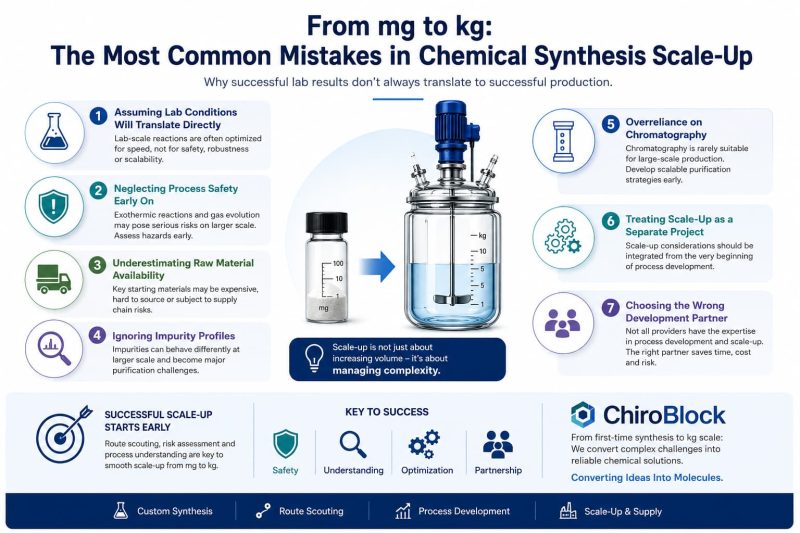
Mistake #1: Assuming That Laboratory Conditions Will Translate Directly
This is arguably the most common error.
A synthesis route developed on a 100 mg or 1 g scale is often optimized for speed rather than manufacturability. Researchers may prioritize proof-of-concept results while overlooking factors that become critical during larger-scale production.
Examples include:
- Excessive reagent equivalents
- Long reaction times
- Difficult temperature profiles
- Use of hazardous reagents
- Reliance on extensive chromatographic purification
While these approaches may be perfectly acceptable during discovery chemistry, they frequently become problematic during scale-up.
The question should never be:
"Can this reaction be performed?"
Instead, it should be:
"Can this reaction be performed reproducibly, safely, and economically at the required scale?"
Mistake #2: Neglecting Process Safety Early in Development
Thermal hazards often remain unnoticed during small-scale experiments.
Exothermic reactions that appear manageable in a laboratory flask can generate significant safety concerns once reactor volumes increase.
Critical factors include:
- Heat accumulation
- Runaway reaction potential
- Gas evolution
- Pressure build-up
- Mixing limitations
Comprehensive process safety assessments should therefore be integrated into development activities before scale-up begins.
Calorimetric studies, reaction hazard evaluations, and thermal stability assessments are not regulatory formalities—they are essential risk-management tools.
Mistake #3: Underestimating Raw Material Availability
A synthetic route may appear elegant on paper but fail commercially because key starting materials are unavailable, prohibitively expensive, or sourced from unstable supply chains.
This issue has become increasingly relevant in recent years due to:
- Global supply chain disruptions
- Geopolitical uncertainties
- Regulatory restrictions
- Sustainability requirements
Experienced process chemists therefore evaluate raw material sourcing at an early stage of route selection.
The best synthesis route is not necessarily the shortest route—it is the route that can be reliably executed for years to come.
Mistake #4: Ignoring Impurity Profiles
Impurity behavior frequently changes during scale-up.
Minor side products observed at milligram scale may become major purification challenges at kilogram scale.
Factors contributing to impurity formation include:
- Different mixing behavior
- Local concentration gradients
- Extended processing times
- Equipment-specific effects
Consequently, analytical development should progress in parallel with process development.
A robust analytical strategy typically includes:
- HPLC
- GC
- LC-MS
- NMR
- Chiral analysis where appropriate
Understanding impurity formation mechanisms early can prevent significant delays later in development.
Mistake #5: Overreliance on Chromatography
Chromatography is an excellent research tool.
However, it is rarely an ideal manufacturing solution.
Many first-time syntheses successfully rely on flash chromatography, preparative HPLC, or other chromatographic techniques during early development. Yet these approaches often become economically unsustainable at larger scales.
Process development should therefore focus on alternative purification strategies whenever possible:
- Crystallization
- Distillation
- Extraction
- Salt formation
- Selective precipitation
Reducing chromatographic dependency is frequently one of the most impactful process optimization measures.
Mistake #6: Treating Scale-Up as a Separate Project
Scale-up should not begin after process development.
Scale-up considerations should be incorporated from the very first feasibility assessment.
This includes evaluating:
- Reaction scalability
- Safety profile
- Purification strategy
- Equipment compatibility
- Raw material sourcing
- Regulatory requirements
Organizations that integrate scale-up thinking early often reach commercial supply faster and at lower overall development cost.
Mistake #7: Choosing the Wrong Development Partner
Many synthesis providers excel at laboratory chemistry.
Fewer possess substantial expertise in process development and scale-up.
The capabilities required for:
- First-time synthesis
- Route scouting
- Process optimization
- Pilot-scale manufacturing
- Supply chain establishment
are not necessarily identical.
Selecting a partner with experience across multiple development stages can significantly reduce technology transfer risks and prevent costly redevelopment efforts.
Route Scouting: The Most Effective Way to Prevent Scale-Up Problems
Many scale-up challenges originate long before the first kilogram is produced.
In fact, they often arise during route selection.
A comprehensive route scouting exercise evaluates:
- Synthetic efficiency
- Safety
- Cost drivers
- Scalability
- Raw material availability
- Intellectual property considerations
- Environmental impact
By identifying potential bottlenecks early, route scouting can eliminate many future scale-up issues before they emerge.
From mg to kg: A Strategic Development Process
Successful scale-up is not the result of a single optimization step.
It is the outcome of a structured development strategy that combines synthetic chemistry, analytical science, process engineering, and risk management.
Organizations that view scale-up as a strategic process rather than a simple increase in batch size are far more likely to achieve:
- Faster development timelines
- Lower manufacturing costs
- Improved reproducibility
- Greater supply reliability
- Reduced technical risk
How ChiroBlock Supports Scale-Up Projects
At ChiroBlock, we support customers throughout the entire lifecycle of complex molecules—from first-time synthesis and route scouting to process development, scale-up, and reliable supply.
Our expertise includes:
- Commercially unavailable compounds
- Research reagents
- Reference standards
- API impurities
- Isotopically labeled compounds
- Functional materials
- Process optimization and route redesign
With more than 25 years of experience in chemical custom synthesis and over 100,000 completed syntheses, we help organizations transform challenging molecular concepts into scalable and reproducible chemical processes.
Related Topics