
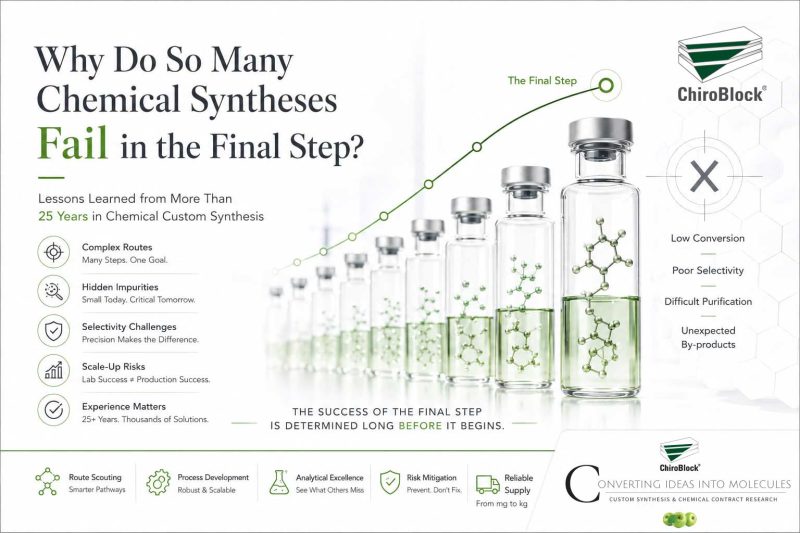
Why Do So Many Chemical Syntheses Fail in the Final Step?
Lessons Learned from More Than 25 Years in Chemical Custom Synthesis
Quick Summary
This article explains why the final step of a chemical synthesis is often the point where complex synthesis projects fail. Rather than being caused by the last reaction itself, failures typically originate from earlier decisions involving route design, impurity management, protecting-group strategy, analytical methods, and process scalability. Understanding these interconnected factors enables more robust, scalable, and economically successful chemical custom synthesis projects.
Key Takeaways
✔ Most last-step failures originate from decisions made much earlier during route development.
✔ Successful route scouting minimizes downstream risks before they become expensive problems.
✔ Trace impurities and protecting-group strategies frequently determine the success of the final transformation.
✔ Reliable analytical methods are essential for identifying root causes and optimizing complex syntheses.
✔ Scalable process development begins long before scale-up and is a key success factor in chemical custom synthesis.
One of the most fascinating—and sometimes frustrating—aspects of chemical custom synthesis is that a project can appear almost complete and still fail at the very last stage.
Over the past 25 years, I have seen numerous projects where the major synthetic challenges had already been solved. The key bond-forming reactions worked. The synthetic route had been established. The target molecule was essentially within reach.
Yet the project still encountered serious difficulties during the final step.
At first glance, this seems counterintuitive. If 95% of a synthesis has already been completed successfully, why should the final transformation become the bottleneck?
From my experience, the answer is surprisingly simple:
The final step is often where all accumulated imperfections of a synthetic route become visible.
Chemistry can be remarkably unforgiving when that happens.
The Myth of the “Easy Final Step”
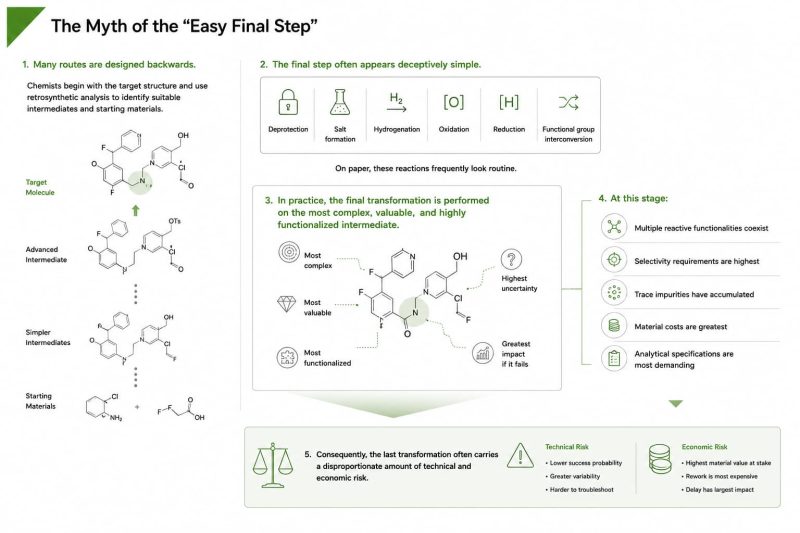
Many synthetic routes are designed backwards.
Chemists typically begin with the target structure and use retrosynthetic analysis to identify suitable intermediates and starting materials.
As a result, the final step often appears deceptively simple:
- Deprotection
- Salt formation
- Hydrogenation
- Oxidation
- Reduction
- ...
On paper, these reactions frequently look routine.
In practice, however, the final transformation is usually performed on the most complex, valuable, and highly functionalized intermediate of the entire synthesis.
At this stage:
- Multiple reactive functionalities coexist
- Selectivity requirements are highest
- Trace impurities have accumulated
- Material costs (that of the final intermediate) are greatest
- Analytical specifications are most demanding
Consequently, the last transformation often carries a disproportionate amount of technical and economic risk.
Small Impurities Become Big Problems
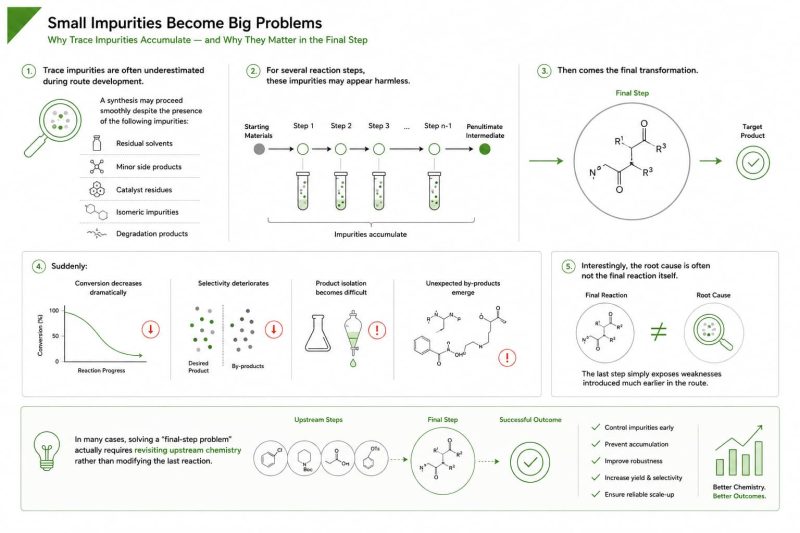
One observation I have made repeatedly is that trace impurities are often underestimated during route development.
A synthesis may proceed smoothly despite the presence of:
- Residual solvents
- Minor side products
- Catalyst residues
- Isomeric impurities
- Degradation products
For several reaction steps, these impurities may appear harmless.
And much efforts have already been made to purify intermediates.
Then comes the final transformation.
Suddenly:
- Conversion decreases dramatically
- Selectivity deteriorates
- Product isolation becomes difficult
- Unexpected by-products emerge
Interestingly, the root cause is often not the final reaction itself.
Instead, the last step simply exposes weaknesses introduced much earlier in the route.
In many cases, solving a “final-step problem” actually requires revisiting upstream chemistry rather than modifying the last reaction.
Protecting Groups: Helpful Allies and Dangerous Enemies
Protecting groups are among the most powerful tools available to synthetic chemists.
They enable transformations that would otherwise be impossible and provide control over complex reactivity patterns.
However, many difficult syntheses eventually converge toward a common challenge:
Removing the protecting groups without damaging the molecule.
Over the years, I have encountered projects where:
- Hydrogenolysis caused decomposition
- Acidic deprotection destroyed sensitive motifs
- Basic conditions triggered rearrangements
- Selective cleavage proved impossible
The irony is that protecting groups often simplify earlier stages while significantly increasing the complexity of the final step.
The longer and more sophisticated a route becomes, the more carefully the deprotection strategy should be considered from the outset.
The Selectivity Challenge
Many custom synthesis targets contain several chemically similar functional groups.
During early development, the primary focus is often whether a reaction works at all.
Toward the end of the synthesis, a different question becomes critical:
Can the reaction be performed selectively enough?
This includes:
- Chemoselectivity
- Regioselectivity
- Diastereoselectivity
- Enantioselectivity
Particularly in chiral synthesis, I have frequently seen situations where a route successfully delivered the desired compound, yet the final transformation compromised stereochemical purity.
When specifications require extremely high enantiomeric excess or exceptionally low impurity levels, even a minor loss of selectivity can become commercially unacceptable.
The Analytical Trap
Another recurring issue is analytical uncertainty.
A reaction may appear successful according to one analytical method while raising concerns according to another.
For example:
- HPLC may indicate excellent purity
- NMR may reveal hidden impurities
- Chiral HPLC may identify stereochemical problems
- LC-MS may uncover unexpected side products
As molecules become more complex, analytical characterization becomes increasingly important.
In some cases, what initially appears to be a synthesis failure is partly an analytical control problem.
Without reliable analytical data, process optimization becomes little more than guesswork.
As process chemists often say:
You cannot optimize what you cannot reliably measure.
Scale-Up Changes Everything
A final step that performs beautifully on a 50 mg scale does not necessarily behave the same way at 500 g or 5 kg.
This remains one of the most common misconceptions in chemical development.
Factors such as:
- Mixing efficiency
- Heat transfer
- Gas-liquid interactions
- Concentration gradients
- Stirrer and reactor geometry
can significantly influence reaction performance.
I have witnessed reactions that delivered nearly quantitative conversion in the laboratory yet became unpredictable during scale-up.
The intrinsic reaction chemistry may be the same, but the process environment has changed.
This distinction is critical for successful process development.
Why the Final Step Often Carries the Highest Economic Risk
From a business perspective, the final transformation often represents the greatest economic risk within a synthesis campaign. This especially applies to linear routes, but also is an issue with convergently designed ones.
At that point:
- All previous development work has already been completed
- Valuable intermediates have been generated
- Raw materials have been consumed
- Timelines are approaching completion
If the final step fails, the consequences extend far beyond a single reaction.
Entire synthesis campaigns may need to be repeated or redesigned.
This is one reason why experienced custom synthesis providers invest significant effort in route scouting, analytical development, process understanding, and risk assessment long before the final transformation is attempted.
What I Have Learned from Difficult Syntheses
After working on thousands of challenging molecules, I have become increasingly convinced that the final step rarely fails because of the final step alone.
More often, it reflects decisions made much earlier:
- Route selection
- Protecting group strategy
- Impurity management
- Analytical development
- Process design
- Scale-up planning
In other words:
The success of the final step is usually determined long before the final step begins.
Preventing Last-Step Failures Through Better Route Design
This is one reason why route scouting remains one of the most valuable activities in chemical custom synthesis.
A well-designed synthetic route does more than simply deliver a molecule.
It reduces risk.
It anticipates scale-up challenges.
It simplifies purification.
It improves robustness.
And it avoids creating problems that only become visible when a project is nearly finished.
In my experience, investing additional effort into route design often saves months of troubleshooting later in development.
Conclusion
Many syntheses fail in the final step not because the chemistry is inherently impossible, but because the last transformation exposes weaknesses that have accumulated throughout the route.
Impurities, protecting-group strategies, selectivity challenges, analytical limitations, and scale-up effects all tend to converge at the stage where success matters most.
For organizations developing complex molecules, the lesson is clear:
The final step should never be treated as an isolated reaction. It is the ultimate test of the entire synthetic strategy. The entire context of all previous steps has to be considered carefully.
Successful chemical custom synthesis therefore depends not only on synthetic expertise, but also on thoughtful route scouting, process development, analytical excellence, and long-term scalability planning.
The final reaction may be the last step in the synthesis.
But in many cases, its success was determined much earlier.
Why ChiroBlock Understands These Challenges
At ChiroBlock, these observations are not based on isolated case studies—they are the result of more than 25 years of solving complex synthetic problems across thousands of custom synthesis projects.
Our work extends far beyond executing individual reactions. We routinely develop entirely new synthetic routes, optimize challenging transformations, solve scale-up bottlenecks, and manufacture complex target molecules that are often unavailable from commercial sources.
Because of this experience, we have repeatedly encountered the same underlying causes of late-stage failures:
- Hidden impurities accumulating over multiple reaction steps
- Protecting-group strategies that create downstream bottlenecks
- Selectivity issues that only become apparent in the final transformation
- Analytical limitations masking the true root cause
- Scale-up effects that fundamentally change reaction performance
Over the years, we have learned that the most efficient solution is rarely to optimize the final reaction in isolation. Instead, successful projects require a holistic understanding of the entire synthetic route—from retrosynthetic planning and route scouting to analytical development, process optimization, and scalable manufacturing.
This systems-level perspective has become one of ChiroBlock's core strengths. Rather than treating the final step as an isolated event, we evaluate the complete synthesis as an interconnected process in which decisions made during the earliest stages determine success at the end.
That philosophy has enabled us to support pharmaceutical, biotechnology, and chemical companies worldwide in developing robust, scalable, and economically viable synthetic processes for highly complex molecules.
After more than two decades in chemical custom synthesis, one conclusion has remained remarkably consistent:
The best way to solve a final-step problem is often to prevent it from being created in the first place.
#ChemicalCustomSynthesis, #ProcessDevelopment, #RouteScouting, #Scale-UpChemistry, #ImpurityControl, #ChiralSynthesis, #SyntheticChemistry, #ContractResearch, #ChemicalProcessOptimization, #ComplexMoleculeSynthesis, #First-TimeSynthesis