
Why Can a 99% Pure Chemical Still Fail in Production?
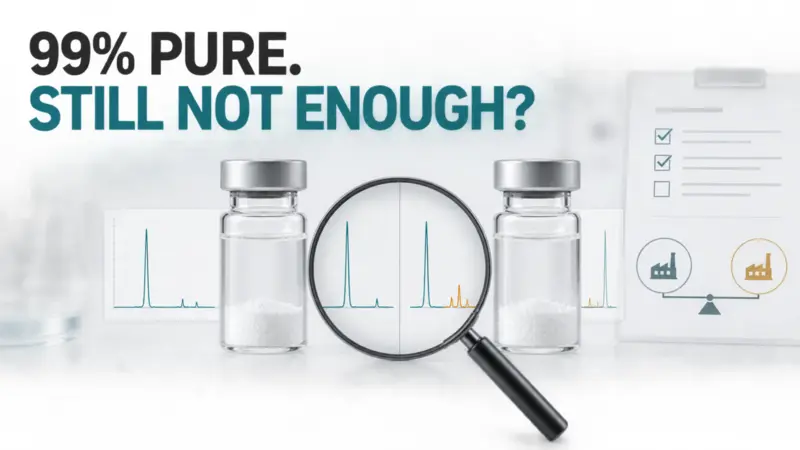
A chemical can meet a stated purity of 99% and still fail in a pharmaceutical, biotechnological or industrial process. The reason is simple: a headline purity value does not identify every impurity, material property or batch-dependent variable that may influence the intended application.
Quick answer: “99% purity” normally describes the proportion assigned to the main compound by a defined analytical method. It does not automatically describe the remaining components, the physical form of the material, the sensitivity of the application or the consistency of future batches.
Key Takeaways
- A purity percentage is only meaningful together with the analytical method used to determine it.
- The identity of a trace impurity can matter more than the total amount of impurities.
- Two batches with the same CAS number and nominal purity may behave differently.
- Good and poor-performing batches can provide the comparison needed to identify critical quality attributes.
- A useful specification connects measurable chemical criteria with the requirements of the application.
- Recurring supply requires a controlled process, suitable release testing and assessment of relevant changes.
- A qualified second source should demonstrate suitability rather than merely reproduce a product name.
What Does 99% Chemical Purity Actually Mean?
A reported purity of 99% means that the main compound accounted for approximately 99% of the result obtained by a particular test under defined conditions. It does not necessarily mean that 99% of the entire material has been fully identified or that the remaining 1% is harmless.
The result may depend on the analytical technique, detector response, sample preparation, integration method, reference standard and calculation basis. An HPLC area percentage, a quantitative NMR result and an assay calculated on a dry basis do not answer exactly the same question.
Before comparing supplier specifications, ask:
- Which analytical method produced the stated purity?
- Were all relevant components detectable by that method?
- Was the result reported on an as-is, dried or solvent-free basis?
- Were water, residual solvents, inorganic residues or metals assessed separately?
- Does the method distinguish relevant isomers or closely related by-products?
A catalogue listing or certificate of analysis can therefore be an important starting point, but it is not always proof that the material is suitable for a specific use. The related article How to Verify the Commercial Availability of a Chemical Compound explains why identity, stock status, specification, analytical evidence and delivery commitment must be evaluated together.
Which Hidden Quality Attributes Can Affect Production?
Application performance can be influenced by chemical impurities, physical material properties and changes introduced during manufacture, isolation, storage or transport.
| Quality attribute | Why it may matter | Possible assessment |
|---|---|---|
| Process-related impurities | Individual by-products may inhibit a reaction, catalyst, enzyme or biological system. | Targeted HPLC, LC–MS, GC–MS or spectroscopic comparison |
| Residual metals or catalysts | Trace residues may affect catalysis, stability or sensitive downstream applications. | ICP-based or other element-specific analysis |
| Water and residual solvents | They may change concentration, reactivity, handling or storage stability. | Karl Fischer titration, loss on drying or headspace GC |
| Isomer or enantiomer ratio | Different isomers may have different chemical, biological or material properties. | Chiral or otherwise selective analytical methods |
| Solid form and particle properties | Polymorph, crystallinity and particle size can influence dissolution, filtration or dosing. | Appropriate solid-state and particle characterization |
| Degradation products | A compliant release result may not predict changes during storage or transport. | Stability-indicating methods and defined storage studies |
Not every project requires every test in this table. The analytical scope should be driven by the material, the observed failure and the intended application.
Why Can Two Batches with the Same CAS Number Behave Differently?
A CAS number identifies a substance, but it does not define the complete quality profile of every batch sold under that identifier.
Different suppliers may use different starting materials, reaction routes, catalysts, work-up operations and purification procedures. Even one supplier may change a raw-material source, process parameter, isolation method or production site. These differences can create distinct impurity profiles or material properties while the main compound and nominal assay remain unchanged.
The comparison should therefore focus on more than the certificate headline:
- Do acceptable and unacceptable batches show reproducible analytical differences?
- Can those differences be connected to starting materials or process history?
- Is the existing analytical method capable of detecting the suspected cause?
- Can the relevant attribute be controlled during synthesis, purification or release?
- Can the customer confirm suitability with a defined application test?
How Should a Batch-Performance Investigation Be Structured?
The most useful starting point is a controlled comparison of material that performs as required with material that does not. Historical certificates, retained samples and customer-side application data may be more valuable than analysing one isolated batch.
- Describe the failure precisely. Record the affected process step, observed deviation and conditions under which it occurs.
- Separate identity from suitability. Confirm the compound identity, then investigate attributes that may explain the performance difference.
- Compare representative batches. Use suitable and unsuitable samples wherever possible rather than relying on theoretical limits alone.
- Develop a testable hypothesis. Connect analytical differences with plausible chemical or physical mechanisms.
- Confirm the attribute experimentally. Prepare, purify, spike or fractionate material where appropriate and compare the result in the application.
- Translate the finding into control criteria. Define an analytical procedure, acceptance limit and responsibility for testing.
This investigation often requires collaboration between the material supplier, an analytical laboratory, a synthesis partner and the organization that owns the functional application test.
What Is the Difference Between Chemical Conformity and Functional Suitability?
Chemical conformity shows whether a batch meets agreed measurable criteria. Functional suitability shows whether that material performs as required in the actual application.
The two are connected but not interchangeable. A synthesis provider can confirm identity, assay, impurity limits or other agreed attributes. A customer may still need to perform a proprietary reaction, biological assay, formulation test or material-performance test that is unavailable to the supplier.
Before a qualification batch is produced, the parties should agree:
- which laboratory performs each test;
- which version of the test method applies;
- how samples are collected and transferred;
- which acceptance criteria determine success;
- how an atypical or conflicting result is investigated; and
- whether application approval is required before repeat manufacture begins.
How Is an Application Requirement Converted into a Chemical Specification?
A useful specification converts the observed application risk into tests and acceptance criteria that can be applied consistently to future batches.
For pharmaceutical development, the ICH Quality Guidelines provide recognized frameworks for specifications and analytical procedures. ICH Q6A discusses tests and acceptance criteria for new drug substances and products, while ICH Q2(R2) and Q14 address analytical procedure validation and development. Their direct applicability depends on the material, development stage, intended use and regulatory context.
A non-API auxiliary chemical is not automatically subject to the same requirements as a drug substance. Nevertheless, the underlying principles remain useful: define what must be measured, use a procedure suitable for its intended purpose and justify the acceptance criteria with relevant evidence.
When Does Custom Synthesis Become Relevant?
Custom synthesis becomes relevant when commercially available material cannot reliably meet the required specification or when the supplier cannot provide sufficient process transparency and change control.
The objective may not be to create a novel molecule. It may be to manufacture an established compound with a different impurity profile, tighter limit, defined physical form or more reproducible process.
A custom synthesis project can include:
- selection of a route that avoids the suspected impurity;
- control of starting-material quality and sources;
- development of a more selective purification or isolation process;
- preparation of comparison samples or a qualification batch;
- development or transfer of suitable analytical procedures; and
- planning for repeat manufacture or transfer to another producer.
The article Custom-Synthesized Molecules explains how customer-specific compounds connect molecular requirements with controlled synthesis, quality systems and scale-up. Cost drivers are discussed separately in Chemical Custom Synthesis Costs Explained.
How Can a Qualified Second Source Reduce Supply Risk?
A qualified second source reduces dependency only when it can reproduce the required quality and has been assessed against the relevant chemical and functional criteria.
Simply buying the same named compound from another catalogue does not establish equivalence. The second-source route, impurity profile, analytical methods, documentation and change controls must be reviewed. Where the application is sensitive, a qualification batch should also undergo the agreed customer-side performance test.
A practical second-source plan normally includes:
- a defined target specification;
- an independent and technically viable manufacturing route;
- qualified starting materials and documented process parameters;
- release testing and traceability;
- a customer-approved qualification batch; and
- clear arrangements for repeat supply, deviations and relevant changes.
What Happened in a Real API Supply-Chain Project?
In one documented project, a commercially sourced auxiliary chemical with a stated purity of 99% repeatedly performed differently in a pharmaceutical API synthesis.
The chemical contract research organization ChiroBlock investigated supplier-dependent variation, developed a reworking option and suitable analytical methods, produced kilogram quantities before the existing stock was depleted and transferred the validated process to another contract manufacturer. The customer ultimately established two independent supply sources and gained knowledge of the critical parameters influencing material performance.
The compound was an auxiliary chemical used in API production. The case does not describe cGMP manufacture of the API by ChiroBlock.
Read the complete source case study by Dr Oliver Seidelmann: Securing the supply chain in API production – an (un)usual task for chemical CROs?
Which Information Is Needed for an Initial Assessment?
- compound name, structure, CAS number and required form;
- current specification and certificates of analysis;
- samples or analytical data from suitable and unsuitable batches;
- a factual description of the observed process or application failure;
- known impurities, suspected mechanisms or relevant target limits;
- required quantity, ordering frequency and expected annual demand;
- storage, packaging, documentation and quality requirements; and
- the available functional application test and its acceptance criterion.
A complete final specification is not always required at the beginning. Comparative data and retained samples can provide the evidence needed to define the investigation.
Conclusion
A 99% purity result is not a universal guarantee of process performance. Reliable use depends on whether the quality attributes that matter to the application have been identified, measured and controlled.
When standard commercial material remains inconsistent, a structured comparison of good and poor batches can reveal the specification gap. Custom synthesis, analytical development and qualification of an independent source can then convert an uncertain material into a reproducible part of the supply chain.
Organizations that need an independent assessment can learn more about the advantages of working with specialized synthesis laboratories or submit a chemical sourcing or synthesis question.
Frequently Asked Questions
Does 99% purity mean that only 1% of the sample is unknown?
Not necessarily. The result depends on the method and calculation basis. Components not detected by the method, including water, inorganic residues or non-responsive impurities, may require separate tests.
Can two batches with the same CAS number have different impurity profiles?
Yes. Different routes, starting materials, reagents, purification steps and storage histories can produce different impurity profiles while the main substance remains the same.
Is a certificate of analysis sufficient to prove application suitability?
Only if its tests and limits cover the attributes that determine suitability for the intended use. A standard certificate may not include application-specific risks.
Who should perform the functional application test?
Normally the organization that owns the process or a designated specialist laboratory. Test responsibility and acceptance criteria should be agreed before qualification.
Can custom synthesis be used for an already known compound?
Yes. The objective may be a customer-specific impurity profile, tighter limit, defined physical form, reproducible process or independent supply source rather than a new molecular structure.
Does a second supplier automatically create a qualified second source?
No. The second source should be assessed against the required specification and, where necessary, a functional application test. Route and impurity-profile differences must be considered.
Is ISO 9001 the same as cGMP?
No. ISO 9001 certifies a quality management system. It does not automatically establish cGMP compliance for a particular product or manufacturing activity.
What is the first step when supplier batches perform differently?
Preserve representative good and poor-performing samples, document the application failure and collect the corresponding certificates, analytical data and supplier information before beginning comparative testing.