How Custom Chemical Synthesis Supports Parasite Research
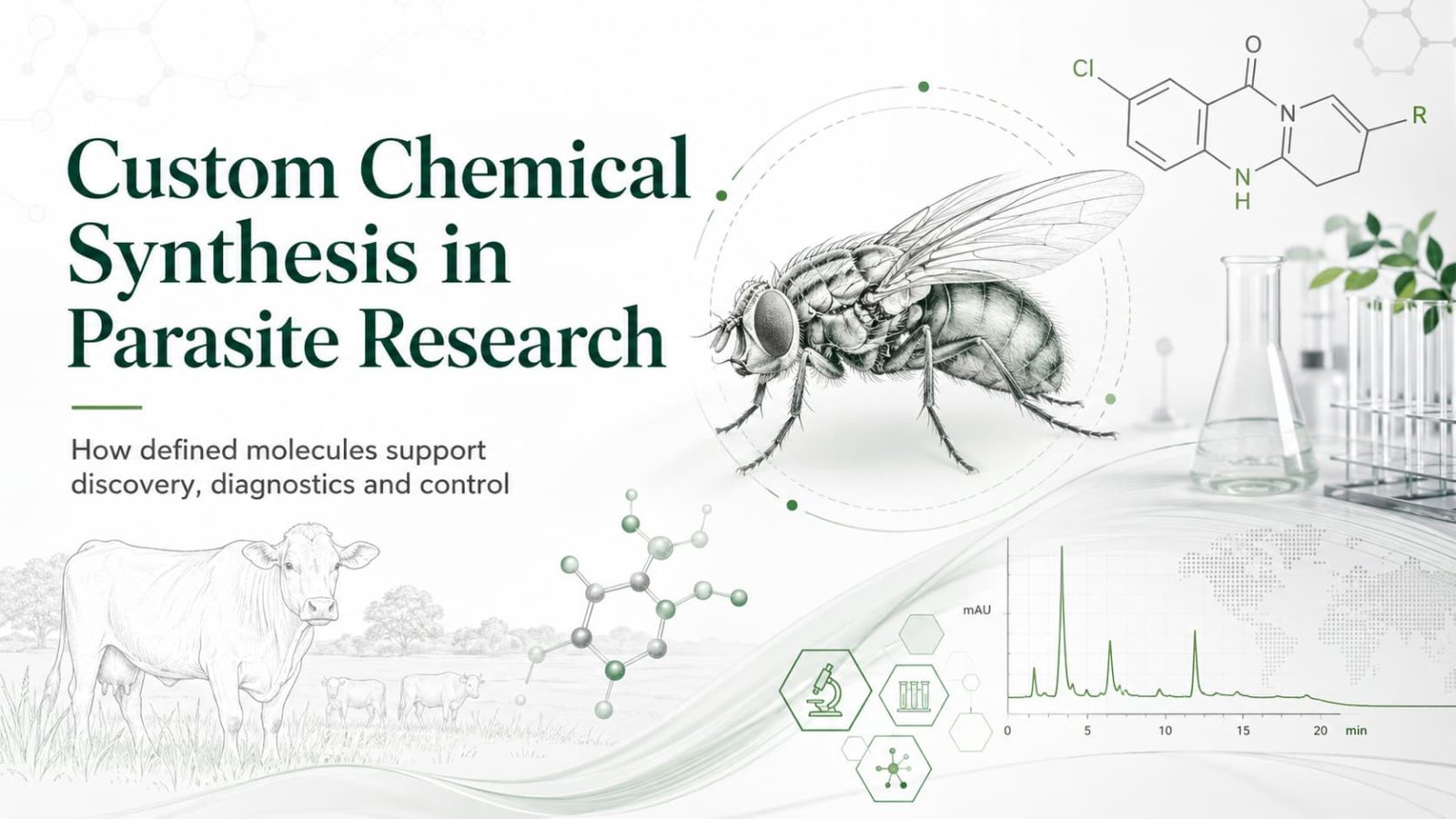
Custom chemical synthesis supports parasite research by providing defined compounds, isotope-labelled molecules, analytical standards and structural analogues that cannot be obtained from conventional chemical catalogues. These research tools allow scientists to investigate biological targets, metabolic pathways, host-finding mechanisms and potential control strategies with greater precision.
Quick answer: Biological research can identify an interesting effect, but understanding that effect usually requires chemically defined materials. Custom synthesis transforms a proposed molecular structure into a characterised research compound that can be tested, compared, traced and reproduced.
The renewed scientific attention surrounding the New World screwworm, Cochliomyia hominivorax, illustrates why interdisciplinary research matters. Control of a complex parasite requires much more than one treatment or one technological platform. It connects veterinary medicine, entomology, genomics, molecular diagnostics, chemical ecology, analytical chemistry and synthetic chemistry.
This article explains where chemical custom synthesis fits into that research landscape. It also examines a documented example in which ChiroBlock supplied specialised compounds for a peer-reviewed parasite study.
Scientific distinction: The cited study investigated parasitic nematodes rather than the New World screwworm. It is included as an example of how defined compounds and isotope-labelled research tools support experimental parasitology. It must not be interpreted as evidence for a screwworm treatment.
Key Takeaways
- Parasite research frequently requires compounds that are novel, unstable, isotope-labelled or otherwise unavailable commercially.
- Defined research compounds help distinguish a real biological effect from the influence of impurities or complex mixtures.
- Structural analogues allow researchers to determine which molecular features are necessary for biological activity.
- Stable-isotope-labelled compounds can support metabolic, distribution and mechanism-of-action studies.
- Chemical ecology depends on defined volatile compounds for the development of traps, attractants and repellents.
- Compound synthesis is an enabling scientific contribution and must be distinguished from biological study design and interpretation.
Why Parasite Research Needs Chemistry
Parasite biology is often studied through observable effects: a compound inhibits development, alters behaviour, reduces motility or changes a measurable metabolic process.
That observation is only the beginning.
Researchers must then determine:
- which molecule caused the effect,
- whether the effect can be reproduced,
- which part of the molecular structure is responsible,
- how the compound enters or interacts with the organism,
- whether it is metabolised or remains chemically unchanged,
- which biological target or pathway may be involved and
- whether the observation is specific to the organism being studied.
These questions cannot be answered reliably with an undefined extract or an incompletely characterised sample. They require compounds with known identity, purity, stereochemistry and concentration.
This is where chemical custom synthesis becomes part of the research process.
What Is Custom Chemical Synthesis in Parasite Research?
Custom chemical synthesis in parasite research is the project-specific preparation of molecules required to investigate parasite biology, diagnostics, behaviour or potential control strategies.
The requested compound may be:
- a previously unknown molecule,
- a natural product or natural-product analogue,
- an enzyme inhibitor,
- a stable-isotope-labelled compound,
- a metabolite,
- an impurity or degradation product,
- an analytical reference standard,
- a fluorescent or affinity probe,
- a volatile attractant candidate or
- one member of a structure–activity relationship series.
The purpose is not simply to manufacture a chemical substance. The synthesis must provide a material that is suitable for the scientific question being investigated.
That requires alignment between:
- molecular structure,
- required stereochemistry,
- target purity,
- analytical documentation,
- quantity,
- formulation or physical form and
- intended biological or analytical application.
Why the New World Screwworm Is a Relevant Research Example
The New World screwworm is a parasitic blowfly whose larvae feed on the living tissue of warm-blooded animals. The resulting wound myiasis can affect livestock, wildlife, companion animals and, less commonly, people.
The United States eliminated established populations in 1966 using the Sterile Insect Technique. Confirmed detections in the United States during 2026 renewed attention to surveillance, sterile-fly production, veterinary preparedness and improved control technologies.
Current epidemiological information is dynamic. Readers should use the USDA New World Screwworm status page for the latest official information rather than relying on static case counts in a scientific article.
The Sterile Insect Technique remains the central area-wide eradication method. Mass-reared sterile males mate with wild females, but the mating produces no viable offspring. Repeated releases can therefore suppress and ultimately eliminate a local population.
However, sterile-fly release is only one part of the research and response system. Modern control also depends on:
- rapid identification of larvae,
- reliable differentiation between sterile and wild flies,
- effective traps and attractants,
- population-genetic tracing,
- veterinary treatments,
- wildlife surveillance,
- ecological modelling and
- production technologies that can operate at very large scale.
Read the complete analysis of New World screwworm biology, livestock risks and current research
Five Ways Custom Synthesis Supports Parasite Research
1. Defined Compounds for Reproducible Biological Experiments
A biological response can only be attributed to a specific molecule when the tested substance has been identified and characterised sufficiently.
Custom synthesis can provide a defined compound when:
- the molecule has only been proposed theoretically,
- the natural source produces insufficient quantities,
- commercial samples are unavailable,
- the required stereoisomer is not offered or
- available material does not meet the required purity specification.
Once a defined compound is available, different laboratories can test the same molecular entity under controlled conditions. This improves reproducibility and allows biological results to be compared more meaningfully.
2. Structural Analogues for Structure–Activity Relationships
A single active compound does not reveal which structural features are responsible for its biological behaviour.
Researchers therefore prepare related molecules in which selected features are modified, for example:
- functional groups,
- chain length,
- degree of saturation,
- stereochemistry,
- ring systems,
- substitution patterns or
- electronic and steric properties.
The biological activity of the resulting series can then be compared. This process is known as a structure–activity relationship, or SAR, study.
A well-designed SAR series can help determine:
- which molecular elements are essential,
- which modifications reduce activity,
- which regions tolerate chemical changes,
- whether selectivity can be improved and
- where a label, linker or reporter group might be introduced.
3. Stable-Isotope-Labelled Compounds
A stable-isotope-labelled compound contains one or more atoms replaced by a non-radioactive isotope, such as carbon-13, nitrogen-15 or deuterium.
The labelled compound generally retains chemical properties similar to those of its unlabelled counterpart while producing a distinguishable analytical signal.
Stable-isotope-labelled compounds can support investigations of:
- metabolic stability,
- degradation pathways,
- formation of metabolites,
- uptake and distribution,
- binding or incorporation,
- mass-spectrometric quantification and
- NMR-based tracing experiments.
Isotopic labelling does not by itself establish a biological mechanism. It provides a research tool that allows the fate of a molecule to be followed more precisely.
4. Volatile Compounds for Chemical Ecology
Parasites and insect vectors often use chemical signals to find hosts, food sources, mating partners or suitable sites for reproduction.
New World screwworm females are attracted to wounds and host-associated odours. Research into these signals may contribute to:
- improved fly traps,
- more selective attractants,
- repellents,
- behaviour-modifying compounds and
- better surveillance strategies.
Natural wound odours are chemically complex. They may contain many volatile compounds originating from the host, damaged tissue, microorganisms and metabolic processes.
Analytical chemistry can identify candidate molecules, but synthesis is often required to obtain each candidate in defined purity and sufficient quantity. Researchers can then test individual compounds and controlled mixtures rather than relying exclusively on variable biological extracts.
5. Analytical Standards and Reference Compounds
Research and diagnostic workflows require reference materials for identification, quantification and method validation.
Custom-synthesised analytical standards may be needed when:
- a compound is newly discovered,
- a metabolite has no commercial source,
- a degradation product must be identified,
- an assay requires an internal standard,
- an impurity profile must be characterised or
- a candidate compound must be compared with a structurally defined reference.
An analytical standard should have an unambiguous identity and a specification appropriate for its intended measurement. A research reference compound may serve a different purpose, such as comparing biological performance across a series of molecules.
Further information on the distinction is available in the overview of customised reference and analytical standards.
A Documented Example: Specialised Compounds for Nematode Research
A peer-reviewed study published in Nature Communications investigated avocado-derived fatty alcohols and related acetates as a potential new class of anthelmintic compounds.
Publication: Fahs, H. Z., Refai, F. S., Gopinadhan, S. et al. “A new class of natural anthelmintics targeting lipid metabolism.” Nature Communications 16, 305 (2025).
DOI: 10.1038/s41467-024-54965-w
The experiments examined free-living and parasitic nematodes. Reported effects included changes in development, motility, survival, respiration and lipid metabolism.
The publication’s chemical-sources section states that ChiroBlock GmbH synthesised:
- avocadane acetate and
- carbon-13-labelled avocadene acetate.
The compounds supported biochemical and analytical experiments within the research programme. The labelled molecule provided a distinguishable analytical signature that could be used to investigate the behaviour of the compound in the experimental system.
Scientific boundary: The study did not investigate Cochliomyia hominivorax, screwworm larvae or wound myiasis. It must not be described as a direct New World screwworm study or as evidence that the compounds treat screwworm infestations.
What the ChiroBlock Contribution Means
The documented contribution demonstrates an important function of a chemical custom synthesis laboratory: enabling biological research through the preparation of specialised compounds.
It does not mean that the synthesis provider:
- designed the biological experiments,
- conducted the parasite or animal studies,
- identified the biological target independently,
- interpreted the complete biological dataset,
- developed a veterinary medicine or
- demonstrated activity against New World screwworm.
The scientifically accurate formulation is that ChiroBlock supplied defined research compounds through custom chemical synthesis.
This distinction strengthens scientific credibility. Research projects frequently involve several specialised partners, each contributing a clearly defined area of expertise.
Direct Screwworm Research and Related Parasite Research Are Not the Same
| Research category | Examples | Scientific relevance |
|---|---|---|
| Direct New World screwworm research | Genome sequencing, fly traps, attractants, sterile-male production and larval diagnostics | Directly investigates the biology, surveillance or control of C. hominivorax |
| Research on related insects | Sensory biology, insect reproduction and control technologies in other fly species | May provide comparative methods that require validation in screwworm |
| Research on nematodes | Anthelmintic compounds, worm metabolism and resistance mechanisms | Provides broader parasitology and chemical-biology insights but is not screwworm research |
| General chemical biology | Inhibitors, labelled compounds, probes and SAR series | Provides experimental methods that may be adapted to different biological systems |
A compound active against a nematode should not be assumed to work against an insect larva. The organisms differ fundamentally in anatomy, metabolism, development and molecular targets.
Transfer between research fields is scientifically valuable only when the relevant hypothesis is tested directly in the target organism.
From Biological Observation to a Research-Ready Compound
A typical chemical-biology project may follow this sequence:
- Biological observation: A natural extract, known molecule or screening hit produces an interesting effect.
- Structural hypothesis: Researchers propose which molecular component may be responsible.
- Compound preparation: The target molecule is isolated, purchased or synthesised.
- Identity and purity confirmation: Analytical methods verify that the required compound was obtained.
- Analogue design: Related structures are selected to investigate structure–activity relationships.
- Biological comparison: Compounds are tested under controlled conditions.
- Mechanistic tools: Labelled compounds, probes or inhibitors are prepared when needed.
- Target investigation: Genetic, biochemical and analytical methods examine the proposed biological pathway.
- Independent validation: Results are reproduced in additional models or laboratories.
The process is iterative. Biological findings guide new synthesis, and new compounds enable more precise biological questions.
When Is Custom Synthesis Necessary?
Custom synthesis becomes relevant when the scientific requirement cannot be met reliably through standard catalogue procurement.
Typical situations include:
- The target molecule is not commercially available.
- Only a different stereoisomer can be purchased.
- The available purity is insufficient for the experiment.
- A stable-isotope-labelled version is required.
- A metabolite or degradation product must be prepared.
- Several closely related analogues are needed.
- The required quantity exceeds the available research supply.
- The compound must be produced repeatedly with consistent quality.
- A synthetic route must be developed for later scale-up.
What Information Should a Research Team Provide?
A well-defined project request improves feasibility assessment, quotation quality and project planning.
| Project information | Why it matters |
|---|---|
| Target structure | Defines constitution, stereochemistry, salt form and labelling position |
| Required quantity | Influences route choice, purification strategy and analytical scope |
| Target purity | Must be aligned with the biological or analytical application |
| Intended use | Clarifies whether the material is intended for screening, assay development, tracing or reference use |
| Required documentation | Defines the expected analytical package and reporting format |
| Known literature | Existing routes or biological data can reduce uncertainty |
| Timeline | Supports realistic resource and project planning |
| Future demand | Allows the route to be designed with repeat synthesis or scale-up in mind |
A molecular structure alone may be sufficient for an initial feasibility review. Additional context enables the synthesis partner to design the project around the actual research objective rather than treating the molecule as an isolated procurement item.
What Should Researchers Expect From a Custom Synthesis Partner?
A professional synthesis partner should provide more than a final vial of material.
Important capabilities include:
- scientific feasibility assessment,
- transparent discussion of technical risk,
- route scouting and literature evaluation,
- appropriate purification strategies,
- identity and purity documentation,
- clear project communication,
- confidential handling of structures and data,
- management of intellectual property,
- options for repeat synthesis and scale-up and
- a quality system appropriate for the project.
ChiroBlock provides first-time synthesis of novel and complex compounds, reference materials, labelled molecules and specialised R&D reagents from milligram to kilogram scale.
Learn more about chemical custom synthesis by ChiroBlock.
What Custom Synthesis Cannot Prove
Scientific claims must remain within the limits of the evidence.
The successful synthesis of a molecule does not prove:
- biological activity,
- selectivity,
- safety,
- clinical or veterinary efficacy,
- a particular mechanism of action or
- transferability from one organism to another.
These questions require appropriate biological, toxicological, pharmacological and regulatory studies.
Custom synthesis creates the material needed to perform those studies. It is an enabling step, not a substitute for biological validation.
Frequently Asked Questions
How does custom chemical synthesis support parasite research?
Custom synthesis provides chemically defined compounds that are unavailable commercially. These may include natural-product analogues, enzyme inhibitors, metabolites, isotope-labelled compounds, analytical standards, probes and structure–activity relationship series.
Why are defined research compounds important?
A defined compound allows researchers to associate a biological observation with a specific molecular structure. Without adequate identity and purity information, an effect may be caused by an impurity, degradation product or mixture rather than the proposed molecule.
What is a stable-isotope-labelled compound?
A stable-isotope-labelled compound contains a non-radioactive isotope such as carbon-13, nitrogen-15 or deuterium. Its distinct analytical signature can support metabolic, distribution, degradation and quantitative studies.
Can custom synthesis support the development of insect attractants?
Yes. Candidate volatile compounds identified in wounds, host odours or microbial samples can be synthesised individually and tested in defined mixtures. This can support the development of more reproducible traps and attractants.
Was the Nature Communications study direct New World screwworm research?
No. The study investigated free-living and parasitic nematodes and potential anthelmintic compounds. It did not investigate Cochliomyia hominivorax, wound myiasis or screwworm treatment.
What did ChiroBlock contribute to the study?
The publication states that ChiroBlock synthesised avocadane acetate and carbon-13-labelled avocadene acetate. ChiroBlock’s documented role concerned compound synthesis rather than biological study design or interpretation.
Can activity against nematodes predict activity against screwworm larvae?
No. Nematodes and insect larvae are biologically distinct organisms. Activity must be tested directly in the relevant species and experimental system.
What should be included in a custom synthesis request?
The most useful information includes the molecular structure, stereochemistry, required quantity, purity, intended application, analytical expectations, timeline and potential future demand.
Summary
Custom chemical synthesis supports parasite research by supplying defined, non-commercial research compounds required for biological, biochemical and analytical experiments.
Relevant compounds include natural products, structural analogues, enzyme inhibitors, metabolites, analytical reference standards, volatile attractant candidates and stable-isotope-labelled molecules.
Defined compounds improve reproducibility and allow researchers to investigate structure–activity relationships, metabolic pathways, molecular targets and analytical methods. Stable-isotope-labelled compounds provide a distinguishable signal for tracing and quantitative analysis.
New World screwworm research combines veterinary medicine, entomology, genomics, molecular diagnostics, chemical ecology and synthetic chemistry. Custom synthesis may support this field through defined attractant components, analytical standards, labelled research tools and novel compounds, but every biological claim requires direct validation in Cochliomyia hominivorax.
The Nature Communications publication with DOI 10.1038/s41467-024-54965-w investigated anthelmintic compounds in nematodes, not New World screwworm. Its methods state that ChiroBlock synthesised avocadane acetate and carbon-13-labelled avocadene acetate. This represents an enabling custom-synthesis contribution and not the development of a screwworm treatment.
Conclusion
Modern parasite research depends on cooperation between disciplines. Biology identifies the question. Analytical science measures the effect. Synthetic chemistry provides the defined molecules needed to test the hypothesis.
The New World screwworm highlights the complexity of contemporary parasite control. Eradication depends on surveillance, veterinary care, population biology, sterile-fly production and continued research. Chemistry contributes where precise molecular tools are required.
The Nature Communications study provides a documented example of this enabling role. ChiroBlock supplied specialised compounds for nematode research while the biological experiments and scientific interpretation remained the responsibility of the study authors and participating institutions.
For research teams, the central lesson is clear: when the required molecule cannot be obtained with the right structure, purity, labelling pattern or quantity, custom chemical synthesis can transform a biological idea into a testable experimental tool.
Discuss a Research Compound
Do you require a novel molecule, stable-isotope-labelled compound, metabolite, analytical standard or structural analogue that is not commercially available?
Submit the target structure, required quantity, purity and intended application for a confidential scientific feasibility assessment.
Discuss your custom synthesis requirement
Sources and Further Reading
- USDA APHIS: Current Status of New World Screwworm
- USDA APHIS: Using the Sterile Insect Technique to Fight Screwworm
- Fahs et al.: A New Class of Natural Anthelmintics Targeting Lipid Metabolism
- ChiroBlock: Chemical Synthesis Service
- ChiroBlock: Customised Reference and Analytical Standards
- Chemical Custom Synthesis Services by ChiroBlock
Editorial note: Current outbreak data, response zones and regulatory information may change rapidly. Operational decisions should always be based on the latest information from the responsible public authorities.
Frequently Asked Questions About Custom Chemical Synthesis in Parasite Research
The following answers explain how defined research compounds, isotope-labelled molecules, analytical standards and synthetic chemistry support modern parasite research.
What is the New World screwworm?
The New World screwworm, Cochliomyia hominivorax, is a parasitic blowfly whose larvae feed on the living tissue of warm-blooded animals. Infestations cause traumatic or wound myiasis and may affect cattle, other livestock, wildlife, companion animals and, less commonly, people.
Why is the New World screwworm relevant to scientific research?
Effective control requires knowledge from veterinary medicine, entomology, genomics, molecular diagnostics, chemical ecology, analytical chemistry and synthetic chemistry. Research supports sterile-fly production, rapid diagnostics, population tracing, veterinary treatments, traps, attractants, repellents and ecological forecasting.
What is custom chemical synthesis in parasite research?
Custom chemical synthesis in parasite research is the project-specific preparation of defined molecules required for biological, biochemical or analytical experiments. These molecules may include natural products, structural analogues, enzyme inhibitors, metabolites, analytical standards, volatile compounds and stable-isotope-labelled research tools.
Why are non-commercially available compounds needed in parasite research?
Many research molecules are novel, unstable, required in a specific stereochemical form or unavailable at the necessary purity and quantity. Custom synthesis gives researchers access to chemically defined materials that can be tested reproducibly and compared across different experiments.
How do stable-isotope-labelled compounds support parasite research?
Stable-isotope-labelled compounds contain non-radioactive isotopes such as carbon-13, nitrogen-15 or deuterium. Their distinguishable analytical signature can support studies of metabolism, degradation, uptake, distribution, metabolite formation and quantitative analytical methods.
How can synthetic chemistry support New World screwworm research?
Synthetic chemistry can provide defined attractant candidates, volatile host-odour compounds, analytical standards, labelled molecules, enzyme inhibitors and structural analogues. These materials may support research into fly behaviour, diagnostics, metabolism, traps, repellents and possible biological targets. Any proposed effect must still be validated directly in Cochliomyia hominivorax.
How can custom synthesis contribute to insect traps and attractants?
Analytical studies may identify volatile compounds associated with wounds, hosts or microorganisms. Custom synthesis can provide these compounds individually and in controlled mixtures, allowing researchers to determine which molecules attract flies and which combinations may improve trap sensitivity or selectivity.
Was the cited Nature Communications study direct research on New World screwworm?
No. The publication “A new class of natural anthelmintics targeting lipid metabolism” investigated free-living and parasitic nematodes. It did not study Cochliomyia hominivorax, screwworm larvae, wound myiasis or a treatment for New World screwworm.
What was ChiroBlock’s documented contribution to the Nature Communications study?
The publication states that ChiroBlock synthesised avocadane acetate and carbon-13-labelled avocadene acetate. These defined compounds supported biochemical and analytical experiments. ChiroBlock’s contribution concerned chemical synthesis and did not include the biological study design, parasite experiments or scientific interpretation.
Can results from nematode research be transferred directly to screwworm larvae?
No. Nematodes are roundworms, whereas New World screwworm larvae are insects. The organisms differ in anatomy, development, metabolism and molecular targets. A compound active in nematodes cannot be assumed to work against screwworm larvae without direct experimental validation.
What role do analytical standards play in parasite research?
Analytical standards help laboratories identify and quantify compounds, metabolites, impurities and degradation products. They may also support method development, assay validation, mass-spectrometric analysis and comparison of results between laboratories.
What is a structure–activity relationship study?
A structure–activity relationship study compares a group of chemically related compounds to determine which molecular features influence biological activity. Researchers may modify functional groups, stereochemistry, chain length or substitution patterns and then compare the resulting effects in a biological assay.
What information is required for a custom synthesis enquiry?
A useful enquiry should include the target structure, stereochemistry, required quantity, target purity, intended application, analytical requirements and preferred timeline. Information about known literature routes, previous synthesis attempts and potential future demand can also improve the feasibility assessment.
What quantities can be prepared by custom synthesis?
Depending on molecular complexity, route feasibility and project requirements, custom synthesis may range from milligram quantities for initial biological experiments to gram or kilogram quantities for extended research, validation or repeated supply.
Does successful chemical synthesis prove biological activity?
No. Successful synthesis confirms that a defined chemical compound has been prepared and characterised. Biological activity, selectivity, safety, mechanism of action and therapeutic relevance must be demonstrated through appropriate biological, pharmacological and toxicological studies.
Where can readers find the latest New World screwworm status?
Case numbers, response zones, movement restrictions and sterile-fly release areas can change rapidly. Current operational information should therefore be obtained from the official USDA APHIS New World Screwworm status pages and the responsible state animal-health authorities.
Additional Insights
The New World screwworm illustrates a broader principle in modern parasite research: effective control rarely depends on a single technology. Progress emerges when biological knowledge, field surveillance, analytical methods and access to defined chemical tools are combined.
1. Eradication Does Not Eliminate the Need for Preparedness
The historical eradication of established New World screwworm populations from the United States demonstrates that coordinated population control can succeed. However, eradication in one geographical region does not remove the parasite from neighbouring endemic areas.
Long-term protection therefore requires sustained surveillance, international cooperation, sterile-fly production capacity, veterinary preparedness and the ability to respond rapidly to individual detections.
2. Early Detection Is Both a Biological and an Economic Control Measure
New World screwworm larvae can enter relatively small wounds and cause progressive tissue damage. Detecting an infestation early can reduce animal suffering, simplify treatment and limit the probability that mature larvae leave the host and continue the reproductive cycle.
Early reporting also reduces the potential operational consequences for farms, including additional labour, veterinary expenditure, production losses and movement restrictions.
3. Surveillance Quality Depends on More Than Case Numbers
A confirmed infestation in an animal does not automatically prove that a self-sustaining wild-fly population has become established in the same location.
Epidemiological interpretation may require several forms of evidence, including animal movement history, larval development stage, nearby cases, fly-trap results, confirmed wild flies and continued transmission over time.
This distinction is important for scientifically accurate communication. A response zone may include unaffected animals and locations without a confirmed case because the zone is designed to reduce the risk of further spread.
4. The Sterile Insect Technique Requires Continuous Innovation
The Sterile Insect Technique remains the foundation of area-wide New World screwworm control. Its effectiveness depends on the ability to produce, transport and release very large numbers of biologically competitive sterile flies.
Research can improve this system through:
- more efficient mass-rearing methods,
- stable male-only production strains,
- improved sterilisation and quality-control procedures,
- better release planning and geographical modelling,
- more sensitive traps and attractants, and
- rapid differentiation between released and wild flies.
A laboratory innovation becomes operationally valuable only when it can be reproduced, scaled, regulated and deployed reliably under field conditions.
5. Chemical Ecology May Improve Detection Before Cases Become Visible
Female New World screwworm flies use chemical signals associated with wounds, animals and microorganisms to locate suitable sites for egg deposition.
Identifying these volatile signals may support the development of more effective traps, attractants and behavioural surveillance tools. Analytical chemistry can identify candidate molecules, while custom chemical synthesis can provide them individually and in precisely controlled mixtures for biological testing.
This approach may help researchers distinguish genuinely active components from compounds that are merely present in a complex natural odour profile.
6. Defined Research Compounds Strengthen Reproducibility
Biological experiments are easier to interpret when the tested material has a confirmed molecular identity, known purity and appropriate analytical documentation.
Custom-synthesised compounds can support reproducible research by providing:
- specific stereoisomers,
- natural products and structural analogues,
- metabolites and degradation products,
- analytical reference substances,
- stable-isotope-labelled molecules, and
- defined compounds for structure–activity studies.
Without chemically defined materials, researchers may be unable to determine whether an observed effect originates from the proposed molecule, an impurity or an undefined mixture.
7. Related Parasite Research Can Generate Methods, Not Direct Conclusions
Findings from one parasite species may inspire new experimental approaches in another field, but they cannot be transferred automatically. Nematodes, parasitic insects and protozoan parasites differ substantially in their physiology, development and molecular targets.
Research on nematodes may provide useful methods for investigating metabolism, compound uptake or target engagement. However, activity against nematodes does not demonstrate activity against New World screwworm larvae.
Scientific interpretation: Related research can generate hypotheses and experimental tools. Biological conclusions require direct validation in the relevant organism and model system.
8. Custom Synthesis Is an Enabling Contribution
A custom synthesis laboratory may make an important contribution to an interdisciplinary research project without designing the biological study or interpreting the complete scientific results.
In the cited Nature Communications study, ChiroBlock synthesised avocadane acetate and carbon-13-labelled avocadene acetate. These compounds supported biochemical and analytical experiments involving nematodes.
This documented role should be described precisely: ChiroBlock supplied defined research compounds through chemical custom synthesis. The study did not investigate New World screwworm and did not demonstrate a screwworm treatment.
Key Insight
Successful parasite control depends on the interaction of field surveillance, veterinary action, population biology, analytical science and access to reproducible research tools.
Custom chemical synthesis supports this process by converting proposed molecular structures into defined compounds that can be tested, quantified, compared and traced. It enables scientific investigation but does not replace direct biological validation.