
From Stadium to Lab: The Molecule Hiding in Plain Sight
Key Takeaways
✔ Football geometry mirrors the C60 fullerene structure.
✔ Fullerenes are important for organic electronics and advanced materials.
✔ Functionalization is the key industrial challenge.
✔ Scale-up determines commercial success.
✔ Custom synthesis enables application-specific derivatives.
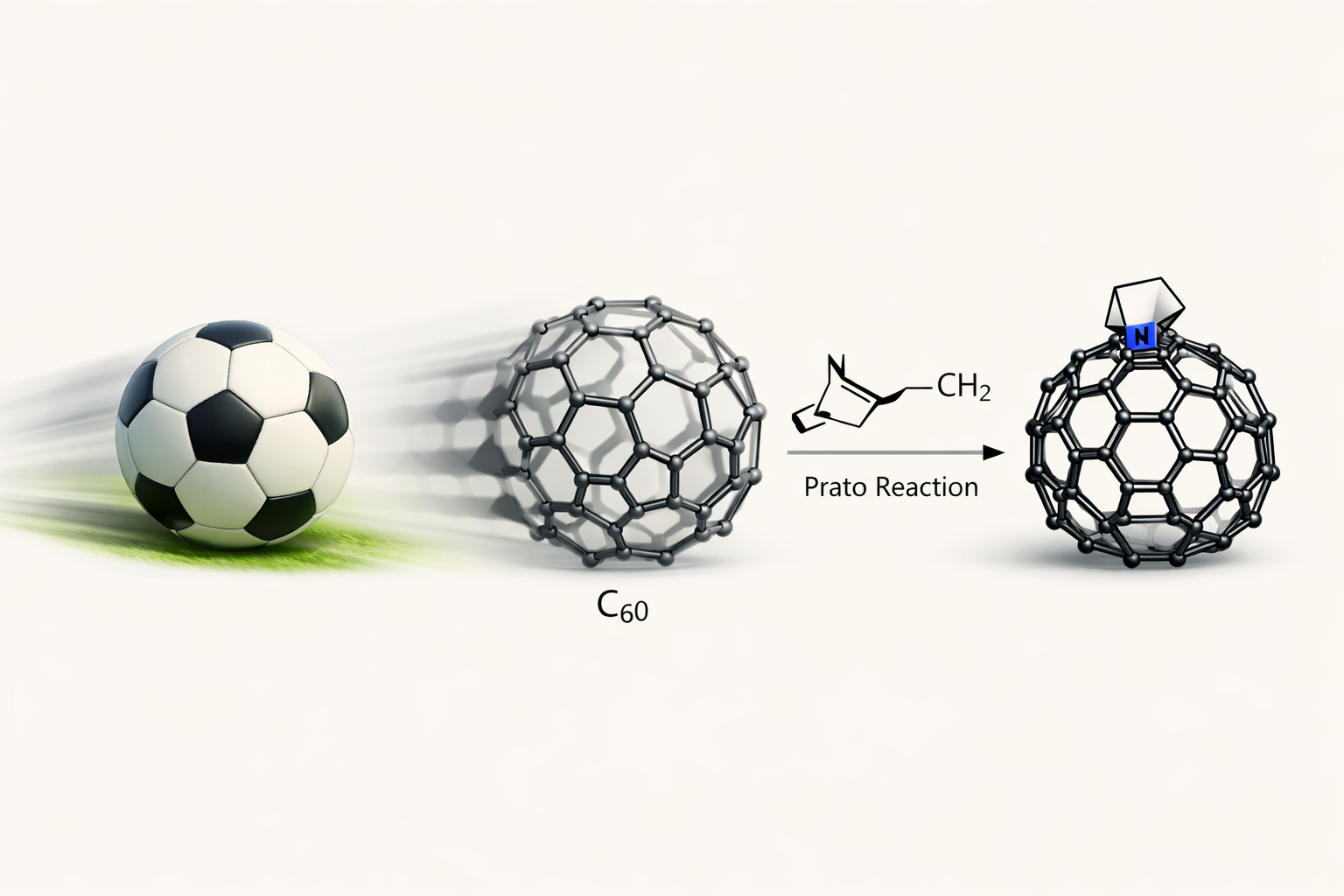
Watching international football, one familiar pattern appears everywhere—the classic ball made of pentagons and hexagons. For most people, it is just design. For me as a chemist, it is instant recognition: Buckminster Fullerene! That geometry – a truncated icosahedron – is exactly the structure of C60.
What makes this particularly interesting right now: the chemistry behind this “simple” structure is directly connected to real industrial challenges we are facing today.
Why fullerenes are back in focus
Across the chemical industry, a key issue is gaining traction both operationally and across professional networks:
The combined pressure of regulatory compliance (REACH, ongoing PFAS discussions), sustainability targets, and the demand for next-generation functional materials.
Fullerenes sit right at this intersection:
- Strong electron acceptors → relevant for organic photovoltaics and electronic materials
- Efficient radical scavengers → applicable in polymer stabilization and potentially biomedical fields
- Highly versatile functionalization platform for tailored materials
Typical reactions we encounter in custom synthesis projects include:
- Cycloadditions (e.g., Bingel reaction or Prato reaction for targeted derivatisation)
- Diels–Alder reactions with conjugated systems
- Radical additions for polymer integration
- Metal coordination for catalytic or electronic applications
From my own experience in contract research:
The real bottleneck is rarely the initial synthesis. It is achieving scalable, reproducible functionalization under regulatory-compliant conditions.
The hidden bottleneck: scale-up and compliance
One issue that is often underestimated in industry: Translating complex molecules like fullerene derivatives from lab curiosity to industrial reality.
Common challenges we repeatedly see:
- Reaction pathways that are difficult to control during scale-up
- Process safety uncertainties with functionalized nanostructures
- A clear gap between academic feasibility and industrial robustness
This is where many promising materials fail — not in innovation, but in execution.
A different way to look at a football
What I find compelling about this analogy:
A globally recognized object reflects a highly sophisticated molecular architecture.
It is a reminder that some of the most powerful ideas in chemistry are already “visible”.
We just need to recognize their potential and translate them into scalable, compliant processes.
#Chemistry #OrganicChemistry #Fullerenes #MaterialsScience #ChemicalIndustry #CustomSynthesis #ContractResearch #ScaleUp #Sustainability #Nanotechnology #ProcessChemistry #Innovation #AdvancedMaterials
What is your perspective? Do you see fullerenes as an academic niche or as an underutilized platform with real industrial breakthrough potential?